 Print this Article
HaRav Yishai Natan –
The pasuk says, “Veyated tihyeh lecha al azenecha.” When going out to war, a person was required to take a shovel with him. Why would someone need a shovel when going to war? A sword makes sense, but why a shovel?
The pasuk explains, “Vechisita et tze’atecha.” After going to the bathroom, a person had to cover up his waste.
We won’t discuss the kli that was needed when going to the bathroom. Rather, we are going to discuss the kli that people commonly use after leaving the bathroom.
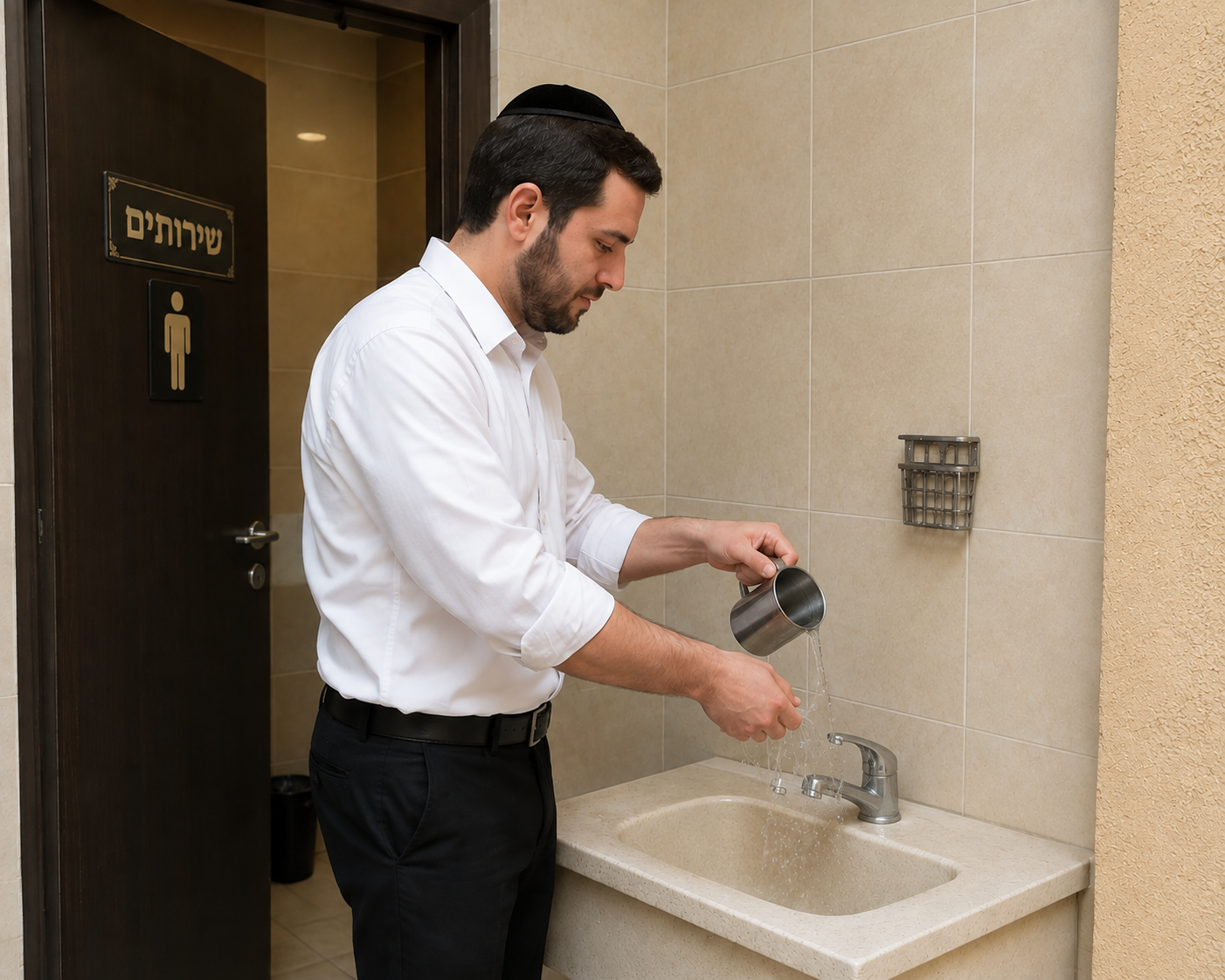
We have all seen people wash their hands with a kli (washing cup) after using the bathroom. The question is: Do you actually need to use a kli?
Washing in the Morning
The Halacha regarding the washing done in the morning, the Shulhan Aruch (Orah Hayim 4:2) says that a person should be careful to wash his hands three times in the morning in order to remove the ruah ra’ah, the impurity that is on his hands. However, the Shulhan Aruch does not say there that a kli is required.
Later, in se’if 7, Maran says, “Tov lehakpid,” that it is proper to be careful to follow the same requirements that apply to netilat yadayim for a meal. For a meal, the washing requires a proper kli and koah gavra, meaning that the water must be poured through the action of a person. Simply turning on a faucet is not sufficient.
Therefore, even for netilat yadayim in the morning, me’ikar hadin, a kli is not required for removing the ruah ra’ah. Nevertheless, Maran says that it is proper to be careful to use one.
Washing After Leaving the Bathroom
Later in the same siman, in se’if 18, the Shulhan Aruch lists several situations that require washing the hands with water. One of them is after leaving the bathroom.
This applies even if a person did not actually use the bathroom. If he walks into an area that has the status of a bathroom and then walks out, he needs to wash his hands because of the ruah ra’ah or tumah that is there.
The Shulhan Aruch also lists other situations that require washing, such as leaving a bet merhatz, cutting one’s nails, getting a haircut or shaving, and touching one’s shoes.
However, when discussing these situations, the Shulhan Aruch simply says that a person must wash his hands. He does not say that he must wash three times, and he does not say that he must use a kli.
Do You Need to Wash Three Times?
The Mishnah Berurah (siman 18) brings a mahloket regarding whether the hands must be washed three times after leaving the bathroom.
The Hechal HaKodesh says that a person should wash three times because of the ruah ra’ah. The Magen Avraham, however, disagrees and says that three washings are not required. It seems that the Mishnah Berurah follows the Magen Avraham that three washings are not necessary.
The Sha’arei Teshuvah brings from the Hida in Mahazik Berachah that, strictly speaking, three washings are not required. However, the Hida writes, “Hazina leRabbanan Kashisha,” that he saw elderly hachamim who did wash three times.
It can be debated whether those hachamim believed that three washings were actually required or whether they were doing so as a humra.
Other poskim, including the Hechal HaKodesh, Shelah, Mahatzit HaShekel, and others, also discuss washing three times.
The Kaf HaHayim writes that it is proper to be mahmir and wash three times. He even writes, “Vehamahmir kadosh yomar lo” — one who is stringent in this matter is called holy.
The Kaf HaHayim questions whether the three washings must be done leserugin, alternating between the hands. He later found that the Ben Ish Hai specifically says to wash “shalosh pe’amim leserugin,” three times while alternating hands. The Ben Ish Hai, sounds like he considers washing three times to be important and not merely an insignificant humra.
The Or LeTzion (Helek 2, siman 1, ot 15) also says that a person should wash three times.
The Yalkut Yosef discusses this as well. It can be debated from his main wording whether he considers it merely a humra or something that should actually be done. In the notes below, however, it sounds more like a humra.
Therefore, although the Shulhan Aruch himself does not require three washings, there is definitely an inyan to wash three times after leaving the bathroom, and perhaps a person should specifically do so.
However, everything we have discussed until now is only about washing three times. None of these sources have required a kli.
A person could seemingly turn on the faucet and wash his hands three times leserugin. There would be no need for someone to pour the water.
Do You Need a Kli?
Now we can address our main question: Do you need a kli after leaving the bathroom?
The Kaf HaHayim quotes the Kaf HaHayim (Hacham Hayim Palachi) and the Hesed LeAvraham regarding various requirements of this washing. They discuss washing three times and having a revi’it of water. They do not mention a requirement to use a kli.
More importantly, the Ben Ish Hai specifically says that although a person should wash three times, a kli is not required.
So where does the practice of using a kli come from?
The Damesek Eliezer
The Minhat Yitzhak, Rav Yitzhak Weiss, discusses this in Helek 5:96. He quotes the Eliyah Rabbah, who brings a mahloket regarding whether a person should preferably follow the same requirements as washing for a meal and therefore use a kli and koah gavra. The Rama says you do, and the Mekor Hayim says you don’t.
There seems to be a mistake in his source. There is no such Rama that says its good to use a kli. The abbreviation in the Eliyah Rabbah is not resh-mem-alef, referring to the Rama. Rather, it is dalet-mem-alef, referring to the Damesek Eliezer.
The Damesek Eliezer says that lechatchilah a person should use a kli. The Eliyah Rabbah, however, argues because the Mekor Hayim says that it is unnecessary.
This is important. If the Rama had actually said to use a kli, we would expect this practice to be much more widespread and clearly established in the Ashkenazi world. Instead, the source is the Damesek Eliezer, and the Eliyah Rabbah brings an opinion that disagrees.
Therefore, me’ikar hadin, a kli is not required. Nevertheless, this appears to be one of the earliest sources showing that there is at least an inyan or humra to use one.
Until this point, we found many sources discussing washing three times, but almost no discussion about using a kli.
The Opinion of Or LeTzion
Another source that discusses using a kli is Hacham Ben Tzion Abba Shaul in Or LeTzion.
He first says clearly that me’ikar hadin, a kli is not required. However, he adds that it is good to use one.
What is his source?
In his notes, he brings the Gra regarding netilat yadayim in the morning. As we explained, even in the morning a kli is not strictly required, although the Shulhan Aruch says that it is proper to use one.
The Gra searches for a source for this practice and cites a Gemara that uses the term netilat yadayim. The word netilah generally refers to washing with a kli. Therefore, the Gra understands that the wording itself indicates the use of a kli.
The Or LeTzion applies this reasoning to washing after leaving the bathroom. Since the Shulhan Aruch also uses the word netilah there, perhaps it is proper to use a kli.
However, this source can be debated. Perhaps only when the Gemara uses the term netilah does it imply a kli. When the later poskim use that term, perhaps it does not necessarily mean that a kli is required.
Furthermore, the Gra was discussing the morning washing, not washing after leaving the bathroom.
Nevertheless, the Or LeTzion concludes that although a kli is not required, there is a humra or inyan to use one.
The Opinion of Yalkut Yosef
The other source that discusses this question is the Yalkut Yosef. His discussion seems to be largely in response to the Or LeTzion.
The Yalkut Yosef questions the idea that whenever the word netilah is used, it automatically means that a kli should be used.
He also argues that the requirement to use a kli in the morning is itself only a humra. Therefore, ain bo ela behidusho — perhaps we should only be stringent where the original humra was stated, namely in the morning, and not extend that humra to washing after leaving the bathroom.
However, he then cites Maran HaHida, who testified that he saw elderly hachamim washing three times. Based on this, the Yalkut Yosef suggests that perhaps it is good to use a kli. There is a major difficulty with this proof. The Hida does not say that those hachamim used a kli. He only says that they washed three times. Therefore, the source proves that there is an inyan to wash three times, but it does not prove that there is an inyan to use a kli.
Even if the Hida had seen them using a kli, it would not necessarily prove that they were particular about using one. In those days, they did not have modern faucets that could simply be turned on. It may have been more practical to fill a kli with water and then wash three times leserugin. Therefore, even if they did use a kli, it would not necessarily be a proof that they considered it necessary.
What Did Hacham Ovadia Yosef Do?
The Yalkut Yosef writes in the notes that Rav Yitzhak Yosef personally observed his father, Hacham Ovadia Yosef, washing his hands many times after leaving the bathroom. Hacham Ovadia did not use a kli. However, he was careful to wash his hands three times under the faucet.
Rav Yitzhak Yosef asked his father about using a kli. Hacham Ovadia responded that using a kli is only a “humra be’alma,” a mere stringency, “Tavo alav berachah” if he wanted to use one.
It can be debated whether there is actually a specific concept of tavo alav berachah for this practice. Nevertheless, anything a person does leshem Shamayim certainly has value. But as far as the actual halachah is concerned, there does not appear to be a requirement to use a kli after leaving the bathroom. Washing three times, however, has a real support in the poskim.