 Print this Article
HaRav Yishai Natan –
The pasuk says at the beginning of Parashat Nitzavim, “Atem nitzavim hayom kulchem” — “You are all standing today.”
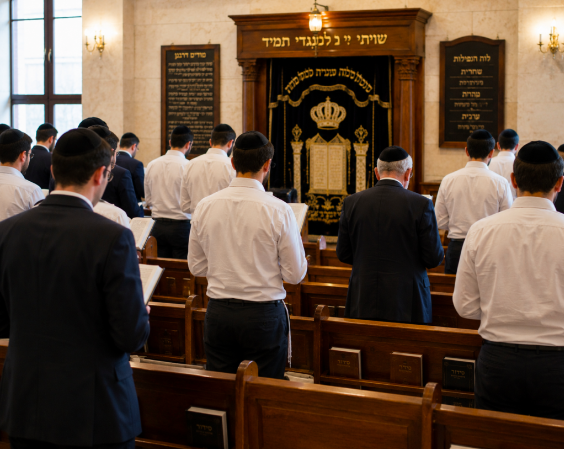
The pasuk is obviously not speaking about the halachot of when we have to stand in the Bet Knesset. However, since the pasuk speaks about standing, we will use the opportunity to discuss some of the common situations in which people stand during tefillah.
One of the most common examples is Kaddish. Among Ashkenazim, everyone generally stands for Kaddish. Sepharadim, however, generally remain seated. Where does this difference come from?
The Source for Standing for a Davar Shebikedushah
The Darkei Moshe, written by the Rama, brings in Siman 56 a Mordechai who quotes a Yerushalmi.
The Yerushalmi discusses Ehud, one of the Shoftim, who went to kill Eglon, the king of Moav. Eglon was a very large man and was sitting when Ehud came before him.
According to this version, Ehud told him, “Kum ki devar Hashem elecha” — “Stand up, because I have a word of Hashem for you.” Even though it was difficult for Eglon to stand, when he heard that he was about to hear a devar Hashem, he stood up. This was considered a great zechut for him.
The Yerushalmi supposedly learns from here that whenever a person says a “davar shebikedushah,” he must stand. According to this, there would be a basis to require standing for things such as Kaddish.
Was This Really in the Yerushalmi?
There is a major problem with this source.
When the Yerushalmi gives us a ruling and the Bavli does not disagree, we would normally follow the Yerushalmi. However, the actual pasuk does not say, “Kum ki devar Hashem elecha.”
The pasuk says, “Devar Elokim li elecha, vayakom me’al hakiseh” — “I have a word of God for you, and he arose from the chair.”
Ehud did not command Eglon to stand. He simply told him that he had a devar Hashem to tell him, and Eglon then chose to stand.
Therefore, the Magen Avraham brings from the Arizal that this supposed passage in the Yerushalmi was actually a ta’ut sofer, a scribal error.
The Kaf HaHayim brings this even more clearly in the name of Rabbi Hayim Vital and the Sha’ar HaKavanot. Rabbi Hayim Vital said that the Arizal told him that this statement was definitely not part of the original Yerushalmi. Rather, a certain hacham had written it into his own copy, and when the Yerushalmi was later printed, that note was mistakenly printed as part of the actual text.
According to the Arizal, then, there is no real source in the Yerushalmi requiring a person to stand for every davar shebikedushah.
The Difference Between Sepharadim and Ashkenazim
This becomes an important mahloket.
The Shulhan Aruch does not bring a requirement to stand for every davar shebikedushah.
The Rama, in Siman 56, writes, “Ve’yesh la’amod” — one should stand. This is the basis for the Ashkenazi custom of standing for Kaddish.
Sepharadim, however, follow the opinion that there is no obligation to stand merely because a davar shebikedushah is being said. Therefore, the Sepharadic custom is generally to remain seated during Kaddish.
Certainly, standing out of respect is a good thing. Anything done leshem Shamayim to show honor for kedushah has value. The discussion here is only whether halachah requires a person to stand.
If You Were Already Standing When Kaddish Began
Even the Darkei Moshe himself brings from the Maharil that a person does not have to stand up when Kaddish begins. However, if he was already standing when Kaddish started, he must remain standing.
The Taz, in a different place in Siman 53, also brings this opinion of the Maharil: You do not necessarily have to get up for Kaddish, but if you were already standing, you should not sit down.
The Arizal acted the same way. If he was already standing when Kaddish began, he remained standing. If he was sitting, he did not stand up.
This is very important for Sepharadim. Everyone knows that the Sepharadic custom is generally to sit during Kaddish. What many people do not realize is that if you were standing when Kaddish started, you should not sit down in the middle.
The Kaf HaHayim says that if you see someone beginning to sit after Kaddish has already started, you should stop him and tell him to remain standing.
This is something that children especially should be taught. If Kaddish has already begun while you are standing, remain standing.
The Kaddish on Friday Night
There is one particular Kaddish for which Sepharadim do have a custom to stand.
The Yalkut Yosef and the Or LeTzion, Helek Bet, bring that on Erev Shabbat, after Kabbalat Shabbat and before Arvit, one should stand for that Kaddish.
The reason is that at that point we are receiving the ruah of Shabbat. Therefore, this Kaddish is different from an ordinary Kaddish. You will see many Sepharadim specifically standing for it.
Even for Ashkenazim, Is Standing an Absolute Obligation?
Even among Ashkenazim, the obligation is not as simple as people sometimes think.
The Mishnah Berurah brings the Taz, who follows the opinion that a person only has to remain standing if he was already standing when Kaddish began.
He then brings that the Magen Avraham follows the Rama and says, “Ve’yesh lehahmir” — one should be stringent and stand.
This wording indicates that even according to the Mishnah Berurah, standing for Kaddish is a humrah. Therefore, if a person is unable to stand, or even if he does not wish to follow that humrah, there is room for him to remain seated.
For Sepharadim, of course, the regular custom is to remain seated.
How Long Must You Remain Standing?
If you were already standing when Kaddish began, how long must you remain standing?
The Maharil, as brought by the Darkei Moshe, says that one should remain standing until “Yehei Shemei Rabbah… le’alam ul’almei almaya.” After that, one may sit down.
The Eliyah Rabbah says that one should remain standing until “da’amiran be’alma, ve’imru amen,” meaning until the end of that section. This makes sense because that entire section is really one unit.
However, Rabbi Shlomo Zalman Auerbach says that one should remain standing until the end of the entire Kaddish.
A Sepharadi in an Ashkenazi Bet Knesset
What should a Sepharadi do if he is praying in an Ashkenazi Bet Knesset, where everyone around him is standing for Kaddish?
The Or LeTzion and Yalkut Yosef say that he should stand with them so that he does not create an issue of “lo titgodedu” by acting differently from the congregation.
However, this depends somewhat on the situation.
Even in an Ashkenazi Bet Knesset, there are often people who remain seated. Some may be elderly, sick, weak, or simply following the opinion that standing is only a humrah.
The Or LeTzion therefore says that if there are already other Ashkenazim sitting, a Sepharadi may remain seated as well.
The main point is that he should not visibly separate himself from the established practice of the congregation.
Standing for Barechu
The next question is whether a person must stand for Barechu. The Shulhan Aruch does not say that one must stand for Barechu. Even the Rama does not discuss Barechu specifically. However, the Rama did say that one should stand for a davar shebikedushah. Therefore, Ashkenazim generally stand for Barechu as well. The Mishnah Berurah discusses this in Siman 146.
There is an interesting detail here. The obligation to stand, according to those who require it, is not necessarily when the hazzan says “Barechu et Hashem hamevorach.” Rather, the relevant time is when you yourself answer, “Baruch Hashem hamevorach le’olam va’ed.”
The reason is that when someone else is saying the davar shebikedushah, you are not the one saying it. When you answer, you are now personally saying a davar shebikedushah.
Therefore, even according to the Ashkenazi approach, theoretically a person could remain seated when the hazzan says “Barechu,” but should stand before answering “Baruch Hashem hamevorach le’olam va’ed.”
The Kaf HaHayim (146), however, brings that according to the Sepharadic custom, there is no obligation to stand for Barechu.
The same issue applies to Barechu when someone receives an aliyah to the Torah.
The Mishnah Berurah, in Siman 146, says that according to this approach one certainly should stand when answering Barechu during Keriat HaTorah.
Interestingly, in regard to Kaddish he described standing as “yesh lehahmir,” a stringency. By Barechu, his language appears stronger.
Nevertheless, in practice, we do not always see Ashkenazim who are sitting suddenly stand just to answer Barechu. That practical custom requires further discussion.
The Kaf HaHayim also brings proof from the Arizal, who did not stand for Barechu.
Standing During Keriat HaTorah
We can now discuss standing during Keriat HaTorah itself.
This issue is already discussed by the Tur.
The Tur brings Rav Sar Shalom Gaon, who says that a person does not have to stand during the Torah reading.
Of course, when the Sefer Torah itself is being carried, everyone must stand because the Torah is moving past them. The question is whether one must remain standing once the Sefer Torah has been placed down, opened, and the reading begins.
Rav Sar Shalom Gaon says that there is no requirement to stand.
However, he says that some people stood because they misunderstood a pasuk: “U’chefitcho amdu kol ha’am” — when he opened it, all the people “amdu.”
At first glance, “amdu” sounds like “they stood.” Therefore, some understood this pasuk to mean that everyone must stand when the Torah is opened.
Rav Sar Shalom Gaon explains that this is incorrect. In this context, “amdu” does not mean physically standing. It means remaining silent.
The lesson from the pasuk is that when the Torah is being read, one must remain quiet and may not speak. It is not a source requiring everyone to physically stand.
The Opinion to Stand During the Entire Reading
The Tur indicates that in his time people generally did not stand for the entire Keriat HaTorah.
However, the Bet Yosef brings from the Mordechai that the Maharam would stand throughout Keriat HaTorah.
The Bet Yosef notes that there were people who followed this practice.
Because of the practice of the Maharam, the Rama writes, “Yesh mahmirim la’amod” — there are those who are stringent to stand.
Notice the wording. The Rama does not say, “Yesh la’amod,” that one should stand. He says that some are stringent to stand.
This indicates that standing throughout Keriat HaTorah is a humrah, not the basic obligation.
Why Did the Maharam Stand?
The Maharam did not necessarily stand because he understood “amdu” in the pasuk literally.
The Bah explains that the Maharam stood as a humrah because listening to the Torah reading is similar to standing at Har Sinai.
At Har Sinai, the Jewish people stood to receive the Torah. Therefore, the Maharam chose to stand while hearing the Torah being read.
According to this, he was not making a mistake in interpreting the pasuk. He was accepting an additional humrah out of respect for the Torah.
The Peri Hadash therefore says that if you see someone standing throughout Keriat HaTorah, you should not object to his practice.
Among Ashkenazim, this custom is very common in certain communities and yeshivot, where people stand throughout the entire Torah reading.
Opinions That Strongly Encourage Standing
The Taz writes that it is “ra’ui linhog keMaharam” — it is proper to follow the practice of the Maharam and stand.
The Lehem Hamudot goes even further and says that one must stand.
Therefore, there are certainly important opinions that support standing during the entire Keriat HaTorah.
The Sepharadic Practice According to the Arizal
The Kaf HaHayim, however, brings from the Sha’ar HaKavanot that the Arizal did not stand during Keriat HaTorah. He remained seated.
This is also a proof that the Arizal apparently remained seated for Barechu during the Torah reading.
The Kaf HaHayim additionally brings from the Petah Devir that according to Kabbalah, a person should specifically sit during Keriat HaTorah.
The exact Kabbalistic reason for sitting requires further explanation, but the practical Sepharadic tradition follows the practice of remaining seated during the Torah reading.