 Print this Article
HaRav Yishai Natan –
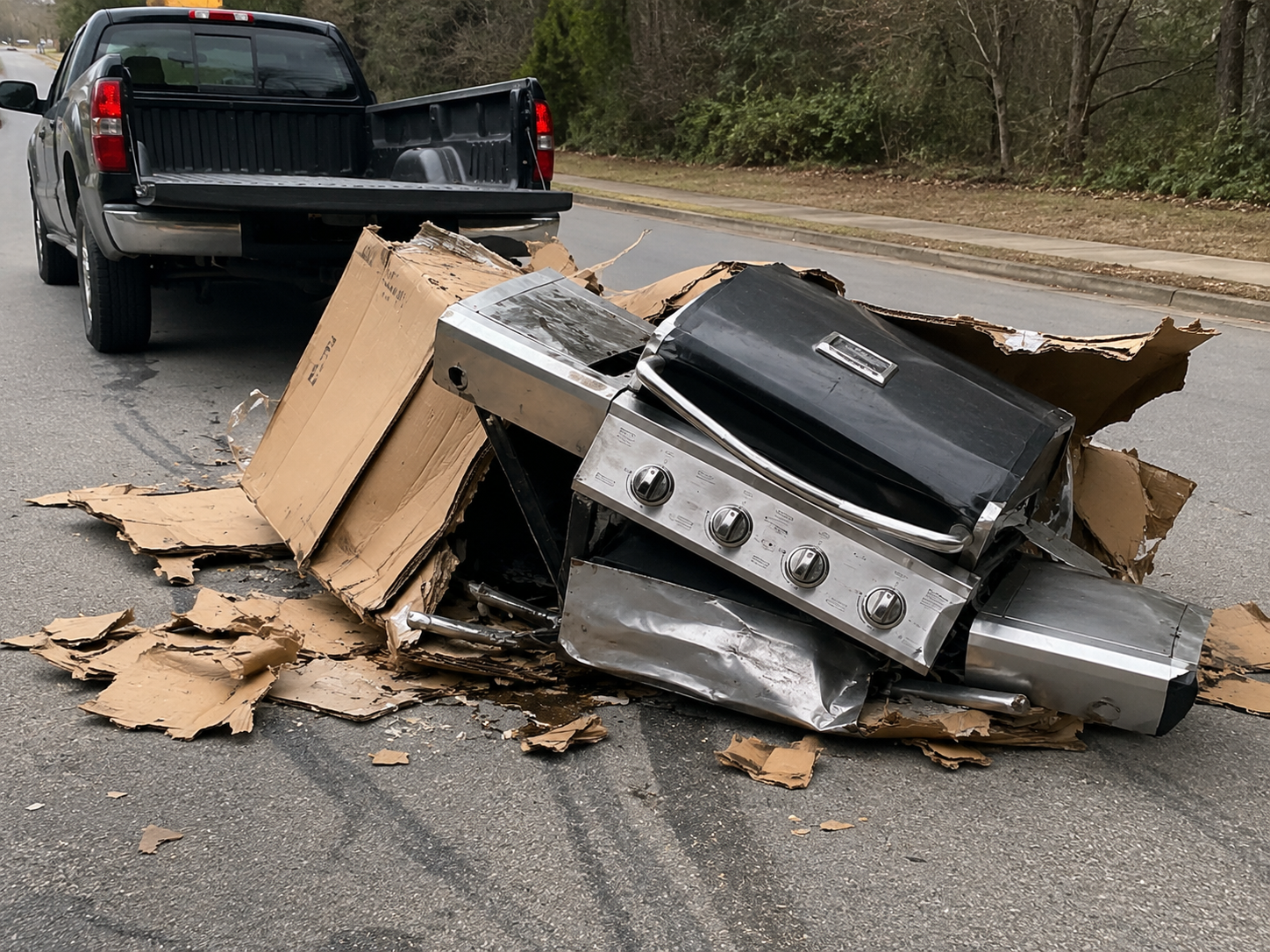
My friend wanted to buy a barbecue grill that was on sale at Home Depot. Since he has a small car and I have a pickup truck, he asked whether I would be going there soon. I told him that I would be nearby the next day, so he asked me to buy the grill and bring it to his house. I agreed. I purchased the grill with my credit card and placed it in the back of my uncovered pickup truck. I regularly transport things there, and nothing has ever fallen out. This time, however, I drove over a large pothole, and the grill flew out of the truck and was run over. It is now completely broken. My friend doesn’t want to pay me now because the grill is broken, but I already paid for it.
Could it be that even though I was doing my friend a favor, I would still be responsible for paying for his broken grill?
Who Owns the Grill?
First, we must determine who owned the grill when it was destroyed. If the grill already belonged to your friend and you were merely a shomer on his grill, then he would still have to reimburse you for the purchase.
However, if your friend did not yet own the grill and it remained yours until you delivered it to him and does a kinyan, then the grill was destroyed while it was still yours. In that case, your friend would be patur from paying you, and you would have to absorb the loss.
Rabbenu Yeruham vs. The Rosh
The Gemara (Baba Kama 102b) discusses someone who sent a messenger to purchase wheat, but the messenger bought barley instead. Rav Yohanan held that although the messenger changed the instructions, the sender still owns the barley and would get profits that come from it. In Eretz Yisrael, they laughed at this ruling. They argued that the sender could not own the barley because the seller did not know that the buyer was acting as a messenger. Therefore, the seller did not intend to transfer ownership to the sender, rather to the messenger.
The Bet Yosef (HM 183:3) cites Rabbenu Yeruham, who rules like Beneh Eretz Yisrael. If a messenger used his own money, the sender does not acquire the item, because the seller thinks he’s transferring ownership to the messenger, not the sender.
The Bet Yosef questions this because the Rosh, the rebbe of Rabbenu Yeruham, rules like Rav Yohanan. The seller does not need to know the true buyer’s identity. Since the messenger intends to acquire the item for the sender, the sender acquires it.
The Bet Yosef suggests that there may be no mahloket. The Rosh discusses a messenger using the sender’s money, while Rabbenu Yeruham discusses a messenger using his own money. Their wording supports this distinction, although the Bet Yosef questions why Rabbenu Yeruham says his ruling is clearly stated in the Gemara when it’s really not.
It is therefore unclear how Maran understood these opinions. Perhaps there is a mahloket, and the halachah follows the rebbe, the Rosh, over his student. If so, the grill belonged to your friend, and he must reimburse you. You would only be a shomer hinam over the grill and would be liable only for negligence. The grill flying out after you hit a large pothole does not appear to be negligence.
Alternatively, perhaps even the Rosh agrees that when the messenger uses his own money, the item belongs to him until the sender acquires it. If so, the grill would still be yours and your friend would be patur[1]. You would not be able to be reimbursed according to this.
Rabbenu Yeruham and Rosh vs. The Ramah
Fortunately, Maran rules in the Shulhan Aruch (HM 183:4) like a third opinion, the Ramah. The Ramah writes that even when a messenger uses his own money, the sender acquires the item if he told the messenger, “Be zocheh in it for me.” If he merely said, “Go get it for me,” the sender does not acquire it. So even if the Rosh agrees to Rabbenu Yeruham[2], it would come out that the Rosh and Rabbenu Yeruham disagree with the Ramah, and Maran sides with the Ramah[3]. In this case, your friend said, “Go buy it for me.” This is similar to saying be zocheh in the grill on his behalf. Therefore, he acquired it and must reimburse you.
Where’s the Kinyan?
The question arises how the sender becomes obligated to pay without a kinyan. Ketzot HaHoshen and Netivot HaMishpat answer that this is based on motzi mamon al pi havero. When a messenger spends or risks money based on the sender’s instructions, the sender becomes liable like an arev, a guarantor[4].
Rav Moshe Feinstein vs. Maran
However, Rav Moshe Feinstein[5] ruled in a similar case that the issue remains a safek, if to go like the Rosh and Rabbenu Yeruham, or like the Ramah. He writes that there may be greater reason to follow the Rosh and Rabbenu Yeruham over the Ramah, since they were later authorities.
He also questions the comparison to an arev. His case involved a messenger purchasing merchandise expected to produce a profit. An arev becomes liable when someone faces a possible loss, such as a lender who might not be repaid. Purchasing profitable merchandise does not create the same type of risk.
Here, however, you paid and lost your own money without any opportunity of profit. It is therefore possible that even Rav Moshe would agree that your friend is liable like an arev. Still, at the time of purchase, there may not have been a potential loss because you had a receipt and could have returned the grill. Additionally, since you used a credit card, you had not yet paid anything yet[6]. Rav Moshe’s opinion would probably still hold strong.
The Final Halacha
In conclusion, according to Rav Moshe Feinstein, the matter may remain a safek. Since your friend is muhzak in his money, he could argue that he does not have to pay.
The Sephardic psak, however, would go according to Maran, and your friend must reimburse you. By saying, “Go buy it for me,” he instructed you to acquire the grill on his behalf. The grill therefore became his, and he must repay you, possibly based on the law of an arev. You are not liable for the damage because you were only a shomer hinam, and the grill was not destroyed through negligence.
[1] Many poskim understand it like this, that there is no mahloket, including the Shach (183:2) and Ketzot HaHoshen (183:3).
[2] As the Shach and others conclude.
[3] The Shach (183:2) also understands that both the Rosh and Rabbenu Yeruham agree that the sender does not acquire an item purchased with the messenger’s money. Nevertheless, he concludes that everyone agrees the sender acquires it when he specifically asks the messenger to be zocheh for him. His final ruling therefore agrees with Maran.
[4] For example, if Reuven tells a lender to lend money to Shimon and guarantees repayment, Reuven becomes obligated once the lender risks his money. He cannot later claim that he merely spoke without making a kinyan. The Ketzot HaHoshen adds from the Tur that the messenger’s payment is viewed as a loan to the sender. The item is therefore considered purchased with the sender’s money. According to this reasoning, even Rabbenu Yeruham would agree that the sender owns it.
[5] Iggerot Moshe, Hoshen Mishpat 1:48
[6] This can be debated, since placing himself under a future obligation may itself be considered a present financial risk.