 Print this Article
HaRav Yishai Natan –
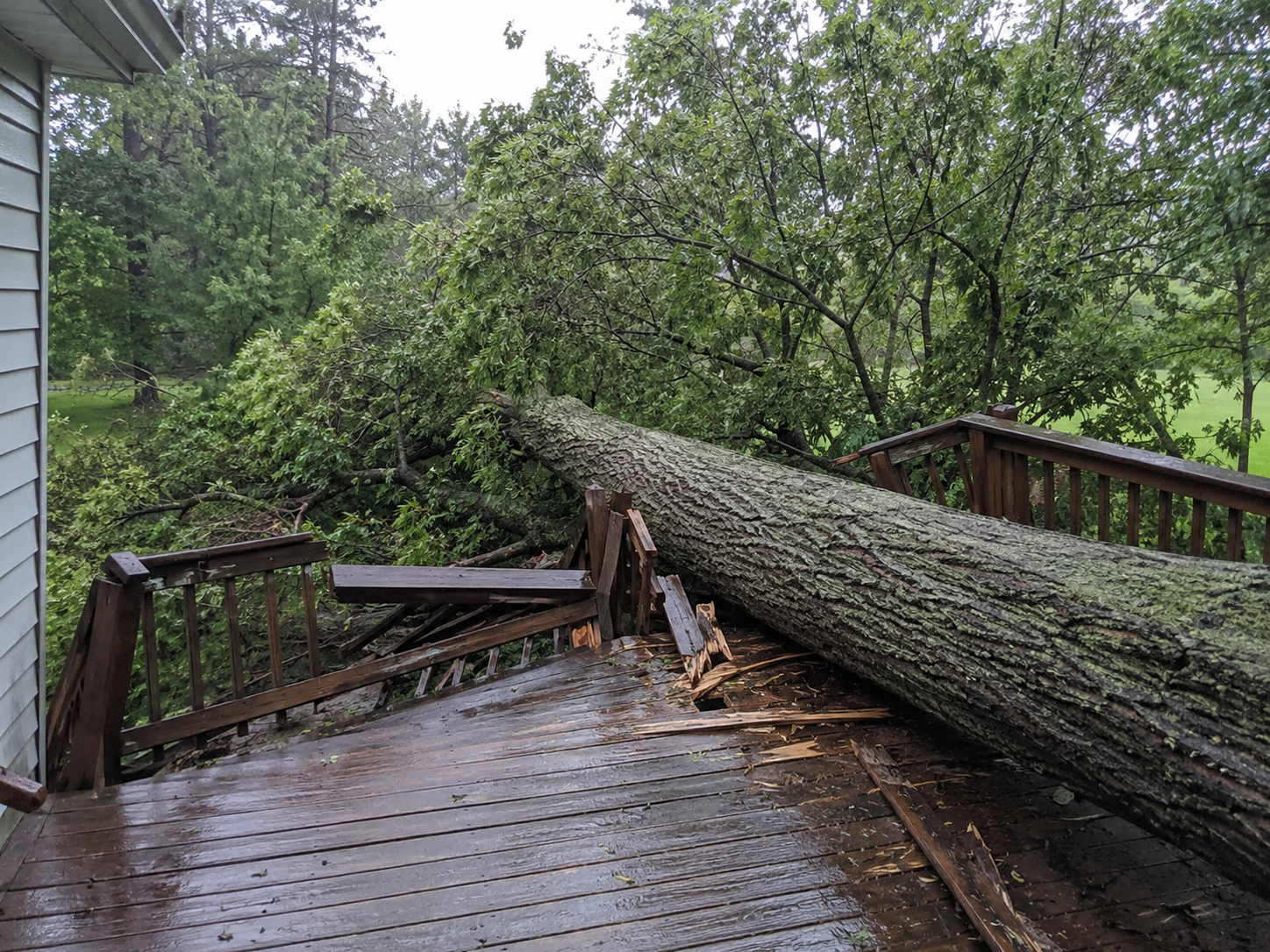
My neighbor has an old tree on his property that looked like it was going to fall any day. I told him that he should cut it down, because it might fall and break something. He never cut it down, and yesterday it fell into my property and destroyed my deck. I told him that now he has to pay for my deck and remove his tree from my property. He thinks he does not have to do either one.
Is he hayav to pay for my deck and to remove his tree from my property?
The Gemara[1] brings a beraitta about a tree that fell into the public domain and caused damage. If the owner was not warned beforehand, he is an oness and is patur. If he was warned, and it fell within the time Bet Din gave him to cut it down, he is still patur. But if it fell after that time, he is a negligent and is hayav. Maran, in Shulhan Aruch[2], brings this beraitta lehalacha.
At first, one would think that since you warned him, he should be hayav. However, there are two major reasons why he would be patur.
First, Maran and the Rama write that the warning must come from Bet Din. A regular person’s warning is not enough[3]. Therefore he is still considered oness and will be patur.
Second, even if your warning would count, he would still be patur for the deck since the fallen tree is in a damage category called Bor, and Bor is only hayav for damage to animals, and is patur for damage to objects like the deck[4].
However, if there were winds that caused the tree to finally fall, it would be in a damage category of fire[5]. In that case, he would be hayav according to the second reason, but would still be patur because of the first reason[6].
Regarding who must remove the tree, the Gemara says that if someone’s wall falls onto his neighbor’s property, the owner of the wall cannot tell his neighbor, “Keep the bricks and remove them yourself.” Rather, the owner must remove them. Maran rules this way, and there does not seem to be anyone who argues[7]. Based on this, your neighbor should have to remove the tree.
However, Tosafot[8] holds that if someone’s wall or tree falls through oness, the owner may make it hefker and avoid the obligation to remove it. It seems like Maran[9] agrees to this, so it could be that when we do not allow him to avoid removing the bricks, that is only when he did not make them hefker.
And even if one needs to make it hefker in front three people, however, since a dead tree in someone’s property is usually worthless, it’s automatically made hefker[10]. Based on this some batei din hold the owner of the tree can say kim li like Tosafot and be patur from removing the tree.
However, HaRav Shlomo Zafrani, in Mishpat Shlomo[11], gives several reasons why the owner remains hayav to remove it. First, Rashi[12] seems to argue on Tosafot and holds that he is hayav even if he is mafkir it.
Second, the Rashash[13] explains that hefker only helps when the wall or tree falls into the public domain, not when it falls into another person’s private property.
Third, Tosafot HaRosh holds that once the tree already caused damage, the owner can no longer make it hefker[14]. Your case would be called a damage since the tree is preventing you from using your property normally[15], and because it destroyed your deck.
Most importantly, Maran in Shulhan Aruch (166:1) writes plainly that if the owner says, “Keep the tree,” and refuses to remove it, we do not listen to him. If Maran held like Tosafot that the owner can simply make it hefker, he should have said so. Since Maran left it unexplained, it seems that Maran does not rule like Tosafot. All these reasons together are enough not to be able to say kim li like Tosafot and the owner must remove it.
In conclusion, your neighbor is patur from paying for the deck, either because your warning did not count as a proper warning and he is oness, or because the damage is considered Bor, and Bor is patur on objects. However, he could be hayav to remove the tree from your property.
[1] Baba Kamma 6b
[2] Shulhan Aruch Hoshen Mishpat 416:1
[3] (Shulhan Aruch HM 416:1). The Torat Hayim explains that if a regular person warns him, the owner can say, “I did not think it was really going to fall.” But if Bet Din warns him, he must take it seriously. According to this, if the tree was so dead that it was obvious to everyone that it would fall, he would not be able to make that claim, and he could be hayav even if someone else warned him (Torat Hayim, brought in Pitheh Hoshen, Nezikin 8:57).
However, the Sma in the Perisha explains differently. He says the reason Bet Din must warn him is because otherwise the owner can say, “I did not know that I would be hayav if it fell.” According to this, even if the tree was clearly dangerous, he could still be patur, since he can claim to follow the Perisha (Perisha HM 416).
[4] The Sma brings that Tosafot is unsure which damage category this falls under. It cannot be called Bor, because Bor is stationary, while this tree damaged while moving. It also cannot be called fire, because fire moves through another force, like wind, and here it just fell on its own. However, the Rosh concludes that the category is Bor (Sma HM 416:2; Tosafot BK 6b; Rosh ibid).
[5] since it involved both the damaging object and the wind that moved it.
[6] Mishpat Kehalacha 416
[7] Baba Metzia 118a; Shulhan Aruch Hoshen Mishpat 166:1
[8] BM 118a
[9] Maran (Shulhan Aruch HM 412:4) writes that if someone was carrying a pitcher, tripped, and the pitcher broke, he is an oness. If he was mafkir the broken pieces, he is not hayav if someone gets hurt from them. If he did not make them hefker, he is hayav.
[10] There is a debate whether hefker must be done in front of three people. However, since a dead tree is usually worthless, the Shach and Sma hold that everyone agrees he can make it hefker on his own. The Mahaneh Ephraim uses this idea to answer a seeming contradiction in Maran (Shach HM 261:3; Sma HM 412:7; Mahaneh Ephraim, Hilchot Hefker 1).
[11] Dinei Shechenim 2
[12] BM 118a
[13] Ibid.
[14] For example, if it fell into his neighbor’s garden and prevents him from planting, that is already damage. The Hazon Ish (Baba Batra 14:16) also discusses this idea (Tosafot HaRosh, brought in Shitah Mekubetzet BM 118a).
[15] HaRav Zafrani does mention that the Gidulei Shemuel (BM 118a) says only a garden is considered damage, because it prevents planting, but a regular yard may not be considered damage. However, HaRav Zafrani argues and says that preventing normal use of a yard is also damage. In this case, there was definitely damage, since the tree destroyed the deck. Even though he is patur from paying for the deck for other reasons, it is still considered damage, and that would not allow him to make the tree hefker, even according to the Gidulei Shemuel.