 Print this Article
By Rabbi Yishai Natan: LISTEN TO THE FULL SHIUR BELOW
In this week’s parasha, Vayishlah, we find an interesting disagreement between Yaakov Avinu and Rahel Imenu over naming their child. As Rahel was passing away after giving birth, the pasuk (Bereshit 35:18) says:
“ויהי בצאת נפשה כי מתה ותקרא שמו בן אוני ואביו קרא לו בנימין”
Rahel named her son Ben Oni, meaning “son of my sorrow,” while Yaakov changed his name to Binyamin. This raises an interesting question: Who has the right to choose a child’s name, the father or the mother? Who are we allowed to name after? Who should we name after?
What’s in a Name?
When parents give their newborn child a name, are they simply choosing a name they like, or is there something deeper taking place? Does a person’s name have a connection to his neshamah? Can a name influence his life?
Midrash Tanhuma — Vayakhel 1: The Midrash teaches that a person has three names: the name given to him by his parents, the name by which other people know him, and the name he earns for himself through his actions. The Midrash emphasizes that the most important name is the one a person earns through his deeds.
Gemara — Berachot 7b: The Gemara teaches shema garim, meaning that a person’s name can have significance. It derives this from the verse in Tehillim 46:9, which the Gemara interprets as referring to the names Hashem places in the world.
Gemara — Yoma 83b: Rabbi Meir would examine people’s names. Once, while traveling with Rabbi Yehudah and Rabbi Yosi, he suspected an innkeeper of being dishonest because of his name, Kidor. The other rabbis did not share his suspicion. When the innkeeper later acted dishonestly, Rabbi Meir’s suspicion proved correct.
Arizal — Sha’ar HaGilgulim, introduction 23: The Arizal, as recorded by Rav Haim Vital, explains that when parents give their child a name, it is not merely a coincidence. Hashem places in their minds the name connected to that child’s neshamah and its spiritual source. Although the parents believe they are choosing a name themselves, the Arizal teaches that their choice receives divine guidance. He connects this teaching to the Gemara’s statement that a person’s name has significance.
A child named after a grandparent: The Kabbalistic work Or Torah, Bereshit 14, explains that even when parents name their child after a grandparent or relative, the name is not considered accidental. Hashem guides them toward the name associated with the child’s spiritual source.
Introduction
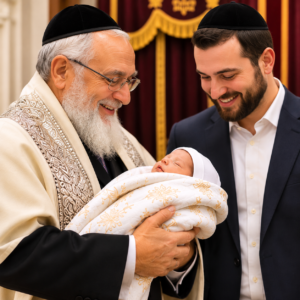
A Sephardic family has a baby boy. The grandfather, Moshe, is still alive. The parents name the baby Moshe in his honor. When the grandfather hears the news, he is delighted. He considers it a tremendous kavod that his grandson carries his name. In an Ashkenazic family, the same situation may produce the opposite reaction. Ashkenazim generally do not name children after living relatives. Instead, they name children after relatives who have already passed away.
How did these two customs develop? Is the Ashkenazic practice based on halacha, ayin hara, or kibbud av va’em? Why do Sephardim consider naming after a living grandparent an honor? And who has priority when choosing a child’s name?
The fundamental difference is one of minhag, not an explicit prohibition in the Gemara against naming after someone alive.
1. The Source of Naming Children After Ancestors
The Midrash (Bereshit Rabbah 37:7) discusses how people chose names for their children:
רבי יוסי אומר הראשונים על ידי שהיו מכירים את ייחוסיהם היו מוציאין לשם המאורע, אבל אנו שאין אנו מכירין את ייחוסינו אנו מוציאין לשם אבותינו.
Rabbi Yosi explains that earlier generations named children after events because they knew their ancestry. Later generations began naming children after their ancestors. Rabban Shimon ben Gamliel gives another explanation: earlier generations possessed ruach hakodesh and chose names accordingly, while later generations named children after their ancestors. However, the Midrash does not say whether the ancestor must have passed away.
2. The Sephardic and Ashkenazic Customs
Sefer Hasidim (460): Rabbi Yehudah HaHasid writes:
נכרים שקוראים לבניהם בשם אביהם אין בכך כלום והיהודים מקפידים על כך ויש מקומות שאין קורין אחר שמות החיים אלא אחר שכבר מתו.
He explains that there are places where people do not name children after living relatives, but only after those who have passed away. Notice his wording: “There are places.” He does not describe a prohibition applying to all Jews. Rather, different communities have different customs.
Hida (Berit Olam, Sefer Hasidim 460): The Hida brings a remez supporting the custom of naming after the deceased from Tehillim (49:12): “קראו בשמותם עלי אדמות.” This is an allusion to the custom, not a Biblical prohibition.
Rav Ovadia Yosef (Yabia Omer 5, Y.D. 21): Rav Ovadia explains that while some communities avoid naming after living relatives, others specifically name children after their living grandparents as an expression of honor and importance. He connects this to the pasuk (Mishlei 17:6): “עטרת זקנים בני בנים”—grandchildren are the crown of the elderly. In these Sephardic communities, naming a child after a living grandfather is a form of kibbud av va’em.
3. Why Do Ashkenazim Avoid Naming After Living Relatives?
Several explanations are given for the Ashkenazic custom.
A. Concern for Ayin Hara: One explanation is that naming a child after a living relative creates an unfavorable association with death. Since Ashkenazim generally name children after deceased ancestors, naming a baby after someone alive might appear as though the family is anticipating that person’s death. Noheg KaTzon Yosef, in the section concerning childbirth, discusses this concern. However, Sefer Hasidim 460 records the custom without explicitly saying that ayin hara is the reason.
B. Preserving the Memory of the Deceased: The Etz Yosef (Bereshit Rabbah 37:7) explains that as generations became shorter and people no longer knew their deceased ancestors, they began naming children after them so their memory would not be forgotten. This explains the value of naming after the deceased, although it does not establish a prohibition against naming after the living.
C. Kibbud Av Va’em: The Shulhan Aruch (Y.D. 240:2) prohibits a person from calling his parents by their first names. There are also restrictions against calling other people by the same name as one’s parent, particularly when the name is unusual or when the parent is present. If a man names his son Yaakov after his father, how can he call his son Yaakov while his father is sitting there? This creates a potential problem of kibbud av va’em.
4. Why Don’t Sephardim Have the Same Kibbud Av Va’em Concern?
The same Shulhan Aruch applies to Sephardim. If a man names his son after his own father, how can he call the child by that name in the grandfather’s presence?
The answer is that giving a child a name and using that name are two separate issues. Naming the child after his grandfather is an honor, but the father must still observe the halachot of calling someone by his parent’s name.
The Rambam (Hilchot Mamrim 6:3) and Shulhan Aruch (Y.D. 240:2) distinguish between common and unusual names and between calling someone in the parent’s presence and elsewhere. One practical solution is to use a nickname when the grandfather is present.
Yalkut Yosef (Hilchot Kibbud Av Va’em 8:8): When a father names his baby after the grandfather at the berit milah, he may announce the name even while the grandfather is present. Since the grandfather is pleased that the child is named after him, announcing the name is an expression of honor rather than disrespect. However, this does not necessarily permit calling the child by that name in the grandfather’s presence afterward.
5. Rabbi Yehudah HaHasid: Marrying Someone With Your Parent’s Name
Rabbi Yehudah HaHasid, in his Tzava’ah, warns against a man marrying a woman whose name is the same as his mother’s, or a woman marrying a man whose name is the same as her father’s.
One explanation is based on kibbud av va’em: if a woman marries someone with her father’s name, she will regularly call her husband by that name, which may be disrespectful to her father.
However, according to this explanation, the concern involves using the parent’s name, not merely having two people with the same name. This helps explain why Sephardim can name children after living grandparents while using nicknames when necessary.
The warning is also explained through ayin hara. The Chazon Ish, as quoted in Pe’er HaDor (vol. 4, p. 90), explains that when a husband and father-in-law have identical names, people may point out this unusual fact, attracting ayin hara. Other poskim understand the warnings of Rabbi Yehudah HaHasid as matters of sod that cannot necessarily be explained through ordinary halachic reasoning.
6. Can a Father Name His Son After Himself?
Hida (Berit Olam, Sefer Hasidim 460): The Hida writes:
ולכל המנהגים אין אדם קורא בנו בשם עצמו
He explains that the general custom is not for a father to give his son his own name, even in communities that name children after living grandparents. He relates an unusual incident involving a man named Mordechai who named his son Mordechai.
Gemara (Eruvin 85b–86a): The Gemara mentions a wealthy man called Bunyus ben Bunyus, meaning that both father and son had the same name. However, this does not necessarily prove that the father was alive when the child was named.
Yemenite Custom: Rav Ben Tzion Mutzafi (Doresh Tzion) discusses the Yemenite practice of naming a son after his own living father. He gives the example of a son named Shalom whose father was also named Shalom. This practice was sometimes considered a segulah for families whose children had not survived.
7. Who Has Priority to Name the First Child?
Da’at Zekenim (Bereshit 38:5): Yehudah named his first son Er, while his wife named their second son Onan. She also named their third son Shelah because Yehudah was away in Keziv. Da’at Zekenim explains that their custom was for the husband to name the first child and the wife the second, taking turns.
Yalkut Yosef (Hilchot Kibbud Av Va’em 8:5): The usual Sephardic custom is to name the first son after the paternal grandfather and the second son after the maternal grandfather. However, some communities have a different custom.
Sedeh Ha’aretz (vol. 3, Y.D. 22): A husband wanted to allow his wife to name their first son after her father instead of his own. Sedeh Ha’aretz explains that this could disrespect the paternal grandfather, since the established custom is to name the first son after him. Furthermore, perhaps the couple will never have another son, and the paternal grandfather will lose the opportunity to have a grandson named after him.
Yalkut Yosef (8:5): The paternal grandfather may waive his honor and allow the first child to be named after the maternal grandfather.
8. Rav Meir Mizrahi: Why Did Nadav and Avihu Die?
Sedeh Ha’aretz (vol. 3, Y.D. 22) quotes Rav Meir Mizrahi (Peri Ha’aretz), who offers an explanation concerning the deaths of Nadav and Avihu. Nadav, Aharon’s first son, was named after his maternal grandfather, Aminadav. Avihu, the second son, was associated with the paternal side. Rav Mizrahi connects their deaths to Aharon not following the proper naming order by giving the maternal grandfather priority.
Rav Ovadia Yosef (Yabia Omer 5, Y.D. 21) challenges using this explanation to establish a danger.
9. His Father Is Alive, but Her Father Passed Away. Who Comes First?
Rav Nissim Ashkenazi (Ma’aseh Avraham, Y.D. 47): Initially, he favored naming the first son after the deceased maternal grandfather because naming a child after someone who passed away brings nahat ruah to the neshama. However, he later reconsidered after seeing Sedeh Ha’aretz and Rav Meir Mizrahi’s explanation concerning Nadav and Avihu.
Rav Ovadia Yosef (Yabia Omer 5, Y.D. 21): He brings the incident recorded in Shu’t HaRashbash 291. The Ramban had a son named Shlomo, who married the daughter of Rabbeinu Yonah. When Rabbeinu Yonah passed away, his daughter was pregnant. According to the normal custom, the baby should have been named Moshe after his living paternal grandfather, the Ramban. However, the Ramban said:
אף על פי שצריך לקרותו על שמי, אני רוצה שיקרא יונה על שם זקנו אבי אמו
“Although he should be named after me, I want him to be named Yonah after his maternal grandfather.”
He explained this through the teaching, “וזרח השמש ובא השמש”—before the sun of one tzaddik sets, the sun of another rises. Since Rabbeinu Yonah had passed away, he wanted the grandson to carry his name.
This demonstrates that even when the paternal grandfather normally has priority, he can allow the maternal grandfather’s name to be used first.
10. His Father Is Mehalel Shabbat, but Her Father Is a Talmid Hacham
Yalkut Yosef (Hilchot Kibbud Av Va’em 8:5): When the maternal grandfather is a talmid hacham, there is additional importance in honoring him because of kavod haTorah. This may provide a reason to give him priority, particularly when the paternal grandfather agrees.
Yalkut Yosef (8:12): If the paternal grandfather is mehalel Shabbat and wants his grandson named after him, the parents may give the child his name when it is also the name of a tzaddik, such as David, intending the name for David HaMelech rather than specifically honoring the grandfather’s conduct. If the grandfather has the name of a known rasha, such as Nimrod or Esav, a different or similar name should be considered.
What if the wife refuses? The fact that her father is a talmid hacham and his father is not religious does not automatically establish that she has naming priority. The usual Sephardic custom gives the paternal grandfather precedence, but the poskim emphasize avoiding arguments. If the parents cannot agree, they should consult a hacham.
11. What If the Parents Come From Different Communities?
A Sephardic mother and an Ashkenazic father: Yalkut Yosef (Hilchot Kibbud Av Va’em 8:6) rules that when the husband comes from a community that does not name children after living relatives, while his wife comes from a community that does, they may name their first son after her living father. This is permitted even though the husband’s community generally avoids the practice.
What if the grandfather insists? Noheg KaTzon Yosef, in the section concerning childbirth, discusses an Ashkenazi grandfather who specifically wanted his grandson named after him. Since the grandfather himself desired the honor, the concern that the family might appear to be anticipating his death did not apply.