Rabbi Yishai Natan:
LISTEN TO THE FULL SHIUR
Sarah’s Burial and Kalev’s Prayer
In Parashat Chayei Sarah, the Torah describes the passing of Sarah Imenu and how Avraham Avinu purchased Me’arat HaMachpelah in Hevron to bury her. This cave would eventually become the burial place of the Avot and Imahot, and one of the most important places for Jewish prayer.
Many years later, when Moshe Rabbenu sent the spies to investigate Eretz Yisrael, the Torah states (Bamidbar 13:22), “ויעלו בנגב ויבא עד חברון” — “They went up through the south, and he came to Hevron.” Why does the verse begin in the plural but continue in the singular? The Gemara (Sotah 34b) explains that Kalev separated himself from the other spies and traveled alone to Me’arat HaMachpelah. There, he prostrated himself upon the graves of the Avot and prayed to be saved from the plans of the spies.
This raises several fascinating questions. Did the Avot hear Kalev speaking? Do our deceased parents know when we visit their graves? And even if they can hear us, are we permitted to speak to them and ask them for help?
Do the Deceased Know When We Visit?
The Gemara (Shabbat 152b) states that the deceased know what is said in their presence, but records a disagreement about how long this continues. One opinion says until the grave is closed, while the other says until the body decomposes. But what happens afterward? Does the deceased lose awareness of everything happening in this world?
The Gemara (Berachot 18b) discusses this question through several fascinating incidents.
The Sons of Rabbi Hiyya
The sons of Rabbi Hiyya were having difficulty remembering their Torah learning. One wondered whether their deceased father knew about their suffering. His brother quoted the verse (Iyov 14:21), “יכבדו בניו ולא ידע ויצערו ולא יבין למו” — his children may be honored or suffer, but he does not know about it. This seems to indicate that the deceased do not know what happens to their children. However, the Gemara challenges this conclusion and brings several stories suggesting otherwise.
The Two Deceased Girls
The Gemara relates that a hasid spent a night in a cemetery and overheard two deceased girls speaking. One suggested that they go and listen behind the Heavenly curtain to learn what would happen in the coming year. The other explained that she could not go because of the condition in which she was buried. The first girl returned with information about a coming agricultural disaster.
The following year, the hasid overheard them speaking again. This time, one refused to share information because their earlier conversation had become known among the living. Apparently, she knew what had happened in this world!
However, the Gemara rejects this proof. Perhaps another person had died in the meantime and informed the girls about what happened. Therefore, the story does not establish that the deceased automatically know everything happening among the living.
Yet Several Halachot Suggest That the Deceased Have Awareness
Lo’eg LaRash — Displaying Mitzvot Before the Dead
The Gemara (Berachot 18a) teaches that one must not display certain mitzvot in the presence of the deceased because of lo’eg larash — mocking someone who can no longer perform those mitzvot. For example, a person must conceal his tzitzit when walking near graves (Shulhan Aruch, O.H. 23:1).
The Ritva (Ta’anit 16a) explains that when people visited cemeteries during public fasts, they did not conduct their regular prayers inside the cemetery, because of lo’eg larash. This also explains why ordinary Torah learning and Shemoneh Esreh should not be performed within four amot of a grave (Shulhan Aruch, Y.D. 367:2–3). Yalkut Yosef (O.H. 90:12) permits regular prayer in a separate room than where the graves are, such as by Me’arat HaMachpelah and the grave of Rabbi Shimon bar Yohai.
Do these laws prove that the deceased hear us? Not necessarily. The prohibition may be based on the dishonor of displaying mitzvot before the dead, even without proving precisely how much they perceive. Nevertheless, the law certainly treats the deceased as deserving respect in their presence.
Asking Forgiveness From Someone Who Passed Away
A stronger example appears in Yoma 87a. The Gemara teaches that someone who wronged another person and did not obtain forgiveness before that person died must bring ten people to the grave and acknowledge the wrongdoing (Shulhan Aruch, O.H. 606:2). The person declares that he sinned against Hashem and against the deceased.
This is particularly interesting because the halacha requires an acknowledgment at the grave itself. It also demonstrates that addressing the deceased in a permitted context is not automatically forbidden. Nevertheless, it does not conclusively establish that every deceased person hears every word spoken at the grave.
Before examining the Zohar’s explanation of how the deceased become aware of visitors, let’s first understand what someone is actually permitted to say at a grave.
What Are We Allowed to Say at the Kever?
May someone say, “Father, please help me,” or “Rabbi Shimon, please pray for me”? Or must every request be directed exclusively to Hashem?
Rabbenu Haim Paltiel — The Concern of Doresh El HaMetim
The Torah states (Devarim 18:11), “וְדֹרֵשׁ אֶל הַמֵּתִים”—prohibiting seeking the dead.
The Gemara (Sanhedrin 65b) explains: “איזהו דורש אל המתים? זה המרעיב עצמו והולך ולן בבית הקברות כדי שתשרה עליו רוח טומאה.” This refers to someone who starves himself and sleeps in a cemetery in order to bring upon himself a spirit of impurity. And so rules Maran (Shulhan Aruch, Y.D. 179:13).
Rabbenu Haim Paltiel, quoted by the Bach (Y.D. 217), raises a concern about people who go to cemeteries to make requests. He suggests that this resembles doresh el hametim. What, then, about Kalev, who asked the Avot to pray for him? He explains Kalev’s visit as prayer to Hashem at a holy place, where prayers are more readily accepted. According to his approach, one should not treat the deceased as someone to whom prayers are directed.
The Bach, Maharil, Shach, Be’er Hetev, Mahatzit HaShekel, and Mishnah Berurah
The Bach (Y.D. 217) defends the established custom of visiting graves, but explains that a person should pray to Hashem in the merit of the deceased. The Shach (Y.D. 179:15) also brings this discussion.
The Maharil (Hilchot Ta’aniyot, 18) writes that the graves of tzaddikim are places of special sanctity where prayer is more readily accepted. Nevertheless, one should not direct his prayers toward the deceased, but ask Hashem for mercy in their merit. This instruction is brought by the Magen Avraham (O.H. 581:16), discussed by the Mahatzit HaShekel there, and recorded by the Be’er Hetev and Mishnah Berurah (581:27).
According to this approach, a person should say, “Hashem, please help me in the merit of my father buried here”.
Ben Ish Hai — One May Ask the Tzaddik to Pray for Him
The Ben Ish Hai (Year One, Nitzavim, 2) makes an important distinction. He first writes that a person must direct his prayers to Hashem, asking for mercy in the merit of the deceased. However, he adds:
“ויכול להשתטח על קבר הצדיק ויאמר הריני מבקש מנפש הצדיק הקבור פה שתתפלל עלי לפני הקדוש ברוך הוא כך וכך.” – A person may address the soul of the tzaddik buried there and ask it to pray before Hashem for a particular need.
In Rav Pe’alim (Vol. 2, Y.D. 31), the Ben Ish Hai discusses a custom in the city of Arbil. During a drought, people would take cattle to the cemetery, slaughter them upon the tombstones of tzaddikim, pray for rain, and distribute the meat to the poor. He strongly prohibits this practice because of concerns involving improper offerings and avodah zarah. During his discussion, he addresses the broader question of how people are permitted to pray at the graves of tzaddikim.
He quotes the Zohar (Aharei Mot, 71b), which asks why Jewish communities go to the graves of tzaddikim when they need rain. Does this not violate doresh el hametim? The Zohar answers that when Jewish people visit the graves of the righteous, they come with teshuvah and broken hearts to request mercy from Hashem. They also seek that the souls of the tzaddikim pray on their behalf.
נמצא לא הותר לאדם להתפלל על קברי הצדיקים, לשאול בקשתו מן הצדיקים עצמן, כי זה חשיב דורש אל המתים, אלא הוא מתפלל ושואל בקשתו מהקב”ה, ורק מבקש מנפש הצדיק שתתפלל עליו לפני הקב”ה, שישמע תפלתו ויעשה בקשתו
Maharam Shik
The Maharam Shik (O.H. 293) also defends asking deceased tzaddikim to intercede. He draws upon the Gemara in Sotah concerning Kalev and the Gemara in Ta’anit (16a), which says that people visit cemeteries so the deceased will pray for them. These are requests for prayer, not attempts to summon the dead through forbidden practices.
Minhat Elazar
The Minhat Elazar (Rabbi Haim Elazar Shapira of Munkatzs) strongly defends the practice of visiting graves of tzaddikim and asking them to pray to Hashem on our behalf. He distinguishes between asking a tzaddik to intercede, which he permits, and praying to the deceased as an independent source of salvation. He brings numerous proofs:
1. Kalev at Me’arat HaMachpelah (Sotah 34b): Kalev directly addressed the Avot, saying, “אבותי בקשו עלי רחמים” — “My forefathers, ask for mercy on my behalf.” Clearly, asking the deceased to pray is permitted.
2. The Deceased Pray for the Living (Ta’anit 16a): The Gemara explains that people visit cemeteries “כדי שיבקשו עלינו מתים רחמים” — so the deceased will pray for them. This applies even to ordinary Jewish graves.
3. Rav Mani at His Father’s Grave (Ta’anit 23b): Rav Mani went to his father’s grave and said, “אבא אבא הני מצערו לי” — “Father, these people are causing me suffering.” The Gemara relates that those troubling him became trapped until they stopped mistreating him. This demonstrates that one may directly address a deceased parent.
4. Yosef at Rahel’s Grave (Sefer HaYashar): When Yosef was taken to Egypt, he passed his mother’s grave, cried, and spoke to her about his suffering. This provides another example of addressing a deceased parent, although Sefer HaYashar is a later narrative source rather than a Gemara.
5. The Arizal: The writings of the Arizal, including Sha’ar HaGilgulim, discuss visiting graves and the spiritual connection between the souls of tzaddikim and the living, supporting the established practice.
6. The Zohar (Aharei Mot 70b–71b): The Zohar directly asks why visiting tzaddikim is not considered doresh el hametim. It explains that righteous souls remain spiritually alive and intercede in Heaven. The nefesh remains connected to the grave and communicates with the ruah and neshama, which seek mercy before Hashem.
7. Tzaddikim Are Considered Alive (Berachot 18a): The Gemara states, “צדיקים במיתתן קרויים חיים.” Since tzaddikim remain spiritually alive, requesting their prayers is different from forbidden attempts to summon the dead.
8. Asking a Living Hacham to Pray (Bava Batra 116a): The Gemara teaches that someone with a sick family member should approach a hacham and ask him to pray. The Minhat Elazar compares this to asking a deceased tzaddik to pray, since in both cases the request is for intercession, not independent salvation.
9. The Definition of Doresh El HaMetim (Sanhedrin 65b): The prohibition concerns practices such as fasting and sleeping in a cemetery to attract impure spiritual forces (Shulhan Aruch, Y.D. 179:13). Simply asking a tzaddik to pray is fundamentally different.
10. Addressing the Soul Versus the Body (Shulhan Aruch, Y.D. 179:14): The Rema distinguishes between seeking the body and addressing the spirit.
11. The Maharil’s Warning (O.H. 581): The Maharil warns not to direct prayers toward the deceased. The Minhat Elazar explains that this prohibits asking the deceased to grant salvation independently, but not asking them to pray to Hashem. He similarly understands the Maharam Shik’s statement, “אבל להמליץ בעדו אין חשש” — asking the deceased to intercede is permitted.
12. Rabbenu Haim Paltiel Did Not Have the Zohar: Rabbenu Haim Paltiel raises the concern of doresh el hametim (Bach, Y.D. 217). The Minhat Elazar argues that he lived before the Zohar became widely available: “שלא נגלה אז עודנה עליהם אור ספר הזוהר.” Had he seen the Zohar’s explanation permitting intercession, the Minhat Elazar argues, he would not have raised the same objection.
13. Visiting Kevarim Is a Mitzvah: Based on the Gemara, Zohar, and Arizal, the Minhat Elazar maintains that visiting the graves of tzaddikim for prayer is a mitzvah, not merely something permitted.
14. The Concern of Tum’ah: The Arizal warns about harmful spiritual forces associated with cemeteries, especially for someone who has not immersed after keri. Nevertheless, the Minhat Elazar distinguishes visiting for a mitzvah purpose and invokes the principle “שומר מצוה לא ידע דבר רע” — someone performing a mitzvah is protected from harm. He still recognizes the importance of purification before visiting.
To summarize: Rabbenu Haim Paltiel raises the concern of doresh el hametim when addressing the deceased, while the Bach, Maharil, Shach, Be’er Hetev, and Mishnah Berurah emphasize that one should pray directly to Hashem in the merit of the deceased, rather than direct prayers to them. The Ben Ish Hai, Rav Pe’alim, Maharam Shik, and Minhat Elazar permit directly addressing a deceased tzaddik to ask him to pray to Hashem on one’s behalf, based on the Gemara and Zohar. All agree that one may not pray to the deceased as an independent source of salvation; the disagreement concerns whether one may ask the deceased to intercede with Hashem.
The Zohar — How the Deceased Become Aware of Our Prayers
The Zohar (Aharei Mot, 70b–71b) describes what happens when the world needs mercy and people visit the graves of tzaddikim.
It distinguishes between three spiritual levels of the soul: nefesh, ruah, and neshama. The nefesh remains connected to the grave and this world. The ruah is associated with the lower Gan Eden, while the neshama occupies a higher Gan Eden.
When people visit the graves of tzaddikim with sincere prayer and teshuvah, the souls become aware of their suffering. The Zohar describes the souls (nefesh) gathering and informing the Avot who rest in Hevron. The nefesh communicates with the ruah, the ruah with the neshama, and the neshama brings the matter before Hashem. All join in seeking mercy for the living, decree kind decrees and Hashem agrees with compassion.
The Zohar also describes this communication in the reverse direction: when mercy is granted from Above, the information descends through the spiritual levels, from the neshama to the ruah and then to the nefesh.
This also explains why the soul does not necessarily need to return physically from Heaven every time someone visits. According to the Zohar, the nefesh already maintains a connection to the grave, while communication takes place through higher spiritual levels.
Is It Dangerous to Visit a Cemetery?
Hacham Ovadia Yosef (Yabia Omer, Vol. 4, Y.D. 35) discusses visiting cemeteries and the spiritual concerns associated with them. Based on kabbalistic sources, cemetery visits may expose a person to harmful forces of tum’ah, particularly someone who has not corrected the spiritual effects associated with keri.
However, the same discussion recognizes the importance of visiting the graves of tzaddikim and one’s parents. When someone visits for a proper mitzvah purpose, the principle “שומר מצוה לא ידע דבר רע” — someone occupied with a mitzvah is protected from harm — is relevant.
Yalkut Yosef (Avelut, 5764 edition, siman 10:25, p. 254) rules that one should generally avoid unnecessary cemetery visits, especially where the spiritual effects of keri have not been addressed. Nevertheless, he explicitly permits visiting the graves of tzaddikim and visiting one’s father or mother to honor them. Even if the person must pass other graves along the way, he may go because the visit is for a mitzvah purpose.
Is There a Mitzvah to Visit One’s Parents’ Graves?
The Gemara (Kiddushin 31b) teaches, “מכבדו בחייו ומכבדו במותו” — a child must honor his parents during their lifetime and after their passing. Maran (Shulhan Aruch, Y.D. 240:9) codifies this obligation. However, neither source explicitly states that a child must visit his parents’ graves.
Yalkut Yosef (Avelut, siman 40:9) describes visiting parents’ graves, particularly on the yahrzeit, as a beautiful minhag, but not obligation.
One possible explanation is that the visit itself expresses honor. Rabbi Akiva Eiger (Teshuvot, Mahadura Kama, 68) distinguishes between serving a parent by providing comfort and performing an act that gives honor and importance to the parent. The second type of kibbud can apply even after death. Accordingly, one can suggest that visiting a parent’s grave expresses respect even when the parent does not directly experience the act.
There is also a more direct explanation: the deceased may actually benefit from the visit.
Sefer Hasidim — The Deceased Receive Pleasure When Loved Ones Visit
Sefer Hasidim (450) discusses Barzilai HaGil’adi, who asked David HaMelech to allow him to die and be buried in his own city (Melachim I 2:6–7). Why did he want to be buried near his family?
Sefer Hasidim explains: “הנייה יש למתים שאוהביהם הולכים על קבריהם ומבקשים לנשמתן טובה” – The deceased receive pleasure when their loved ones visit their graves and pray for their souls.
He continues that these prayers benefit the deceased in the next world, and that when the living request the deceased’s prayers, the deceased can also pray for them, as demonstrated by Kalev’s visit to the Avot.
Yabia Omer (Vol. 4, Y.D. 35) brings this source in discussing the custom of visiting graves, and Yalkut Yosef also cites it in explaining the significance of these visits.
Thus, there are two possible reasons that visiting one’s parents may be considered kibbud av va’em: the child performs an act of respect, and the visit itself may benefit the parent’s soul. Nevertheless, there is no general obligation to visit regularly, even though the practice is praiseworthy.
May Women Visit Cemeteries?
According to the basic halacha, women are not generally prohibited from visiting cemeteries. However, the Zohar (Vayakhel, 196a) warns about women accompanying funerals and the spiritual dangers associated with the Malach HaMavet.
1. The Malach HaMavet Is Found Among the Women
The Zohar (Vayakhel 196a) states: “דהא בשעתא דמיתא אפקי ליה מביתיה לבי קברי, מלאך המות אשתכח ביני נשי” — When a deceased person is taken from his home to the cemetery, the Malach HaMavet is found among the women. Rabbi Shimon bar Yohai explains that this spiritual connection began with the sin of Havah, through which death entered the world. When men accompany the deceased, the Malach HaMavet positions himself among the women in the funeral procession.
2. The Malach HaMavet Can Accuse Those Who Encounter Him
The Zohar explains that the Malach HaMavet observes the faces of those who encounter him during the funeral procession, from when the deceased leaves his home until everyone returns. He can then ascend to Heaven and accuse these individuals by mentioning their sins. If judgment is issued against them, they may die before their expected time.
3. The Zohar’s Instructions
The Zohar instructs men to avoid facing the women during the funeral procession. If the women are walking behind, the men should remain ahead without turning toward them. If the women are ahead, the men should remain behind rather than encounter them face-to-face. When returning from the cemetery, men should also avoid walking toward the women or looking at them. The concern is encountering the Malach HaMavet, who is described as being among the women.
4. A Second Warning in the Zohar
The Zohar (Vayakhel 196b) states: “דהא בשעתא דנשי נטלי רגלייהו עם מיתא, איהו נחית ואשתכח קמייהו” — When women accompany the deceased, the Malach HaMavet descends and is found before them. The Zohar connects this to the verse (Mishlei 5:5), “רגליה יורדות מות” — “Her feet descend toward death.” This reinforces the spiritual concern about women accompanying a funeral procession.
5. Maran Shulhan Aruch Rules According to the Zohar
Maran (Bet Yosef, Y.D. 359) quotes the Zohar: “ובספר הזוהר פרשת ויקהל כתוב שיש למנוע לנשים מלצאת לבית הקברות מפני שאם יוצאות גורמים רעה לעולם וכן ראוי למנעם” — The Zohar states that women should be prevented from going to the cemetery because their participation can bring harm to the world. Maran then rules (Shulhan Aruch, Y.D. 359:2): “יש למנוע מלצאת נשים לבית הקברות אחר המטה” — Women should be prevented from following the funeral procession to the cemetery.
6. The Earlier Source — Berachot 51a
The Gemara (Berachot 51a) records that the Malach HaMavet told Rabbi Yehoshua ben Levi: “ואל תעמוד לפני הנשים בשעה שחוזרות מן המת מפני שאני מרקד ובא לפניהן וחרבי בידי ויש לי רשות לחבל” — Do not stand before women when they return from accompanying the deceased, because I dance before them with my sword in my hand and have permission to cause harm. The Gemara advises moving four amot away, taking another path, or turning one’s face away and reciting “יגער ה׳ בך השטן.”
7. Does This Apply to Women Visiting Graves at Other Times?
An important distinction must be made. The Zohar primarily discusses women participating in a funeral procession, and Maran’s ruling (Y.D. 359:2) specifically concerns women following the deceased to the cemetery. It does not explicitly prohibit a woman from visiting her parent’s grave on the yahrzeit or visiting a kever of a tzaddik at another time.
Yalkut Yosef (Avelut, siman 10:23–24) discusses the warnings of the Zohar and Gra concerning women visiting cemeteries. Nevertheless, he explains that according to the strict halacha, women may enter a cemetery even while they are niddah, and certainly during the shivah neki’im. However, because of the kabbalistic concerns, it is preferable to avoid unnecessary cemetery visits, particularly during menstruation.
The Gra — Women Should Avoid Visiting Cemeteries
The Gra, in his famous letter Alim LiTerufah (Iggeret HaGra), written to his family while traveling toward Eretz Yisrael, strongly warns his wife against visiting cemeteries. He writes:
ותישמר שלא תלך לבית הקברות כלל וכלל. (נוסח אחר: ששם מתדבקין הקליפות מאד, וכל שכן בנשים), וכל הצרות והעוונות באים מזה.
“Be careful not to go to the cemetery at all. (Another version adds: Because the kelipot attach themselves there very strongly, especially to women.) All troubles and sins come from this.” The Gra explains that cemeteries contain harmful spiritual forces, called kelipot, which can attach themselves to visitors, particularly women.
What About a Woman Who Is a Niddah?
The Pit’hei Teshuvah (Y.D. 195:19), citing Hamudei Daniel, discusses the custom of women avoiding cemetery visits during menstruation.
There is a distinction between the days of actual bleeding and the shivah neki’im. Some customs are stricter during bleeding but allow visits during the seven clean days, even before immersion in a mikveh.
Hacham Ovadia Yosef (Taharat HaBayit, Vol. 2, siman 12:44) discusses the issue and explains that there is no basic prohibition preventing a niddah from visiting a cemetery. The concern is based on minhag and Kabbalah, and there is particular room to permit visiting at established occasions such as the seventh day, thirtieth day, and yahrzeit.
Similarly, Yalkut Yosef (Avelut, siman 10:24) explicitly permits women to visit during the days of bleeding according to the strict law, and certainly during the shivah neki’im. Nevertheless, he recommends respecting the stricter kabbalistic practices where they are followed, especially during actual menstruation.
May a Pregnant Woman Visit a Cemetery?
There is no explicit prohibition in the Gemara or Maran’s Shulhan Aruch against a pregnant woman visiting a cemetery. Nevertheless, many communities have a minhag that pregnant women avoid cemeteries. The Minhat Yitzhak (Vol. 10, 42:2) writes there is no basis for this minhag, but discusses this custom and its possible spiritual foundations.
Touching or Kissing the Kever
Some people place their hands on a tombstone while praying, while others kiss the stone as an expression of love and respect.
The Be’er Hetev (O.H. 224:8), citing earlier sources, records a practice of placing one’s hand on a grave. This provides a source for touching the tombstone, although it is not an obligation.
Kissing the tombstone is also practiced in some communities, particularly at the graves of parents and tzaddikim. However, no source has been found about it.
Sitting or Leaning on a Tombstone
Maran (Shulhan Aruch, Y.D. 364:1) rules that a constructed grave is forbidden for personal benefit, although natural ground used for burial is not. The Rema brings a disagreement whether one may sit on a tombstone. Rabbenu Yeshaya prohibits it, while the Rosh permits it because the tombstone is not considered part of the grave itself.
The Taz (364:1), quoting the Maharshal, writes that the accepted custom is not to sit on graves. (Therefore, one should not place their baby on the tombstone for pictures or other reasons.) He also cites the Hagahot Ashri in the name of the Or Zarua, who explains that anything made to honor the deceased is forbidden for personal benefit. Therefore, one may not lean on a tombstone, since he is using it to support his body. The Be’er Hetev (364:1) brings these rulings as well.
However, the Taz distinguishes between standing or sitting on a grave and briefly walking across one. He permits walking across when necessary because merely passing over a grave does not necessarily constitute deriving benefit from it. Hacham Ovadia Yosef (Hazon Ovadia, Avelut, Vol. 1, p. 436) similarly rules that one should avoid stepping on graves, but permits doing so briefly when there is no alternative.
Placing Notes and Invitations on a Grave
Some people write personal prayers on paper and place them at the graves of tzaddikim. Others visit the graves of their deceased parents before a wedding, leaving an invitation or telling them about the upcoming celebration.
1. The Zohar (Pinhas 219b): The Zohar explains that even after a person’s parents pass away, they can participate in his happiness. When someone includes Hashem in his celebration, Hashem brings his deceased parents from Gan Eden to share in the simha, although the living cannot see them.
2. The Source: The Zohar explains the verse (Tehillim 149:2), “ישמח ישראל בעושיו” — “Let Israel rejoice in its Makers.” Why the plural? Because three partners create a person: Hashem, his father, and his mother (Kiddushin 30b). Therefore, when someone celebrates with Hashem, his parents are also included.
3. Happiness Versus Suffering: The Zohar adds: “אבל בעקו דבר נש, קודשא בריך הוא זמין לגביה בלחודוי, ולא אודע לאבוהי ולאימיה” — When a person suffers, Hashem comes to him alone and does not inform his parents. This is especially interesting considering the Gemara (Berachot 18b), which questions whether deceased parents know about their children’s suffering.
4. Inviting Parents to a Wedding: This is not mentioned anywhere, but the custom might be based on this Zohar.
Lighting Candles at the Kever
The Ben Ish Hai, in Torah Lishmah (520), discusses the spiritual significance of lighting candles for the deceased, whether they must be lit at the grave, and how this practice fulfills kibbud av va’em. He also explains the custom of circling the graves of tzaddikim seven times.
1. Why Does Lighting a Candle Benefit the Neshama?
The Ben Ish Hai quotes Rabbenu Bahya (Shemot 25:37), who writes: “וידוע כי הנשמה נהנית בהדלקת הנרות” — The neshama receives pleasure from lighting candles. He explains that the soul originates from spiritual light and therefore has a special connection to light. Just as the Gemara (Berachot 43b) teaches that the soul enjoys pleasant fragrances, which are less physical than food, the soul also benefits from light, which is even more refined. This explains the verse (Mishlei 20:27), “נר ה׳ נשמת אדם” — “The soul of man is the lamp of Hashem.”
2. Why Do We Light a Candle During Shivah?
Citing the Arizal, the Ben Ish Hai explains that during the first seven days after death, the nefesh remains connected to the house where the person passed away. Therefore, lighting a candle there provides spiritual pleasure to the nefesh. After seven days, the nefesh no longer remains there in the same manner. Interestingly, if the deceased passed away somewhere else, there is no special reason, according to this explanation, to light the candle specifically in the house where the family is sitting shivah.
3. Lighting Candles During the First Year and on the Yahrzeit
The Ben Ish Hai writes: “אך טוב להדליק נר תוך י”ב חודש בביהכ”נ למנוחת הנפטר וכן בכל שנה ביום יארצייט” — It is good to light a candle in the bet kenesset during the first twelve months and each year on the yahrzeit. This practice is different from lighting a candle in the house during shivah, since it is dedicated to the elevation of the deceased’s neshama.
4. Must the Candle Be Lit at the Grave?
The Ben Ish Hai writes: “ואז בקריאה זו שהוא מוציאה בפה יגיע הנאה לנפש האדם ההוא אפילו מרחוק וכ”ש אם מדליק על המצבה עצמה ששם משכן חלק מחלקי הנפש” — When someone verbally dedicates a candle to the deceased, the soul benefits even from a distance, and certainly when the candle is lit at the tombstone itself, where part of the nefesh remains connected. Therefore, lighting at the grave has additional spiritual significance, but one does not need to travel there for the neshama to benefit.
5. One Must Verbally Dedicate the Candle
The Ben Ish Hai writes: “אך ודאי צריך להזכיר בפה שהוא מדליק שמן זה למאור למנוחת ולעילוי נשמת פלוני בן פלוני” — A person should explicitly state that he is lighting the candle for the elevation of a particular person’s neshama. He explains that speech has spiritual significance and connects the act to its intended purpose, similar to verbally preparing something in honor of Shabbat. One may say: “הריני מדליק נר זה למנוחת ולעילוי נשמת פלוני בן פלונית.”
6. The Five Colors of the Flame
The Ben Ish Hai explains that a flame contains five spiritual aspects corresponding to the five levels of the soul: nefesh, ruah, neshama, hayah, and yehidah. He connects this to Rabbenu Bahya and Bereshit Rabbah (14:9), which teaches that the soul has five names. This provides a deeper kabbalistic explanation for the connection between candles and the neshama.
7. Lighting Candles Fulfills Kibbud Av Va’em
The Ben Ish Hai writes: “ולכן ודאי טוב ונכון שהנר שמדליקין תוך ז’ בבית וכן תוך י”ב חודש בביהכ”נ וכן בכל שנה ביום יארצייט צריך שהבן עצמו ידליק הנר בידו בעבור אביו או אמו” — It is proper for the son himself to light the candle during shivah, the first twelve months, and on the yahrzeit. He concludes: “ודבר זה נחשב לו בכלל כבוד או”א” — This is considered part of honoring one’s parents. This is an explicit source that lighting a candle for deceased parents fulfills kibbud av va’em, because it brings spiritual pleasure to their neshamot.
8. Circling a Tzaddik’s Grave Seven Times
The Ben Ish Hai also discusses the custom of circling a tzaddik’s grave seven times. He connects it to Masechet Semahot (chapter 6), which describes people in distress walking around the courtyard of the Bet HaMikdash so others would recognize their suffering and pray for them. He also cites the Agudah, who connects this practice to cemeteries. He recommends circling the grave seven times while reciting Eshet Hayil (Mishlei 31:10–31), explaining that the seven circuits correspond to the seven lower sefirot. He connects this to the verse “סובו ציון והקיפוה ספרו מגדליה” (Tehillim 48:13), interpreting tziyun as a reference to the tombstone. This is a meaningful minhag, not an obligation.
Why Do We Place Stones on a Kever?
1. Showing Respect to the Deceased — Derashot Maharash
Derashot Maharash (siman 490), written by Rabbenu Shalom of Neustadt, the teacher of the Maharil, explains:
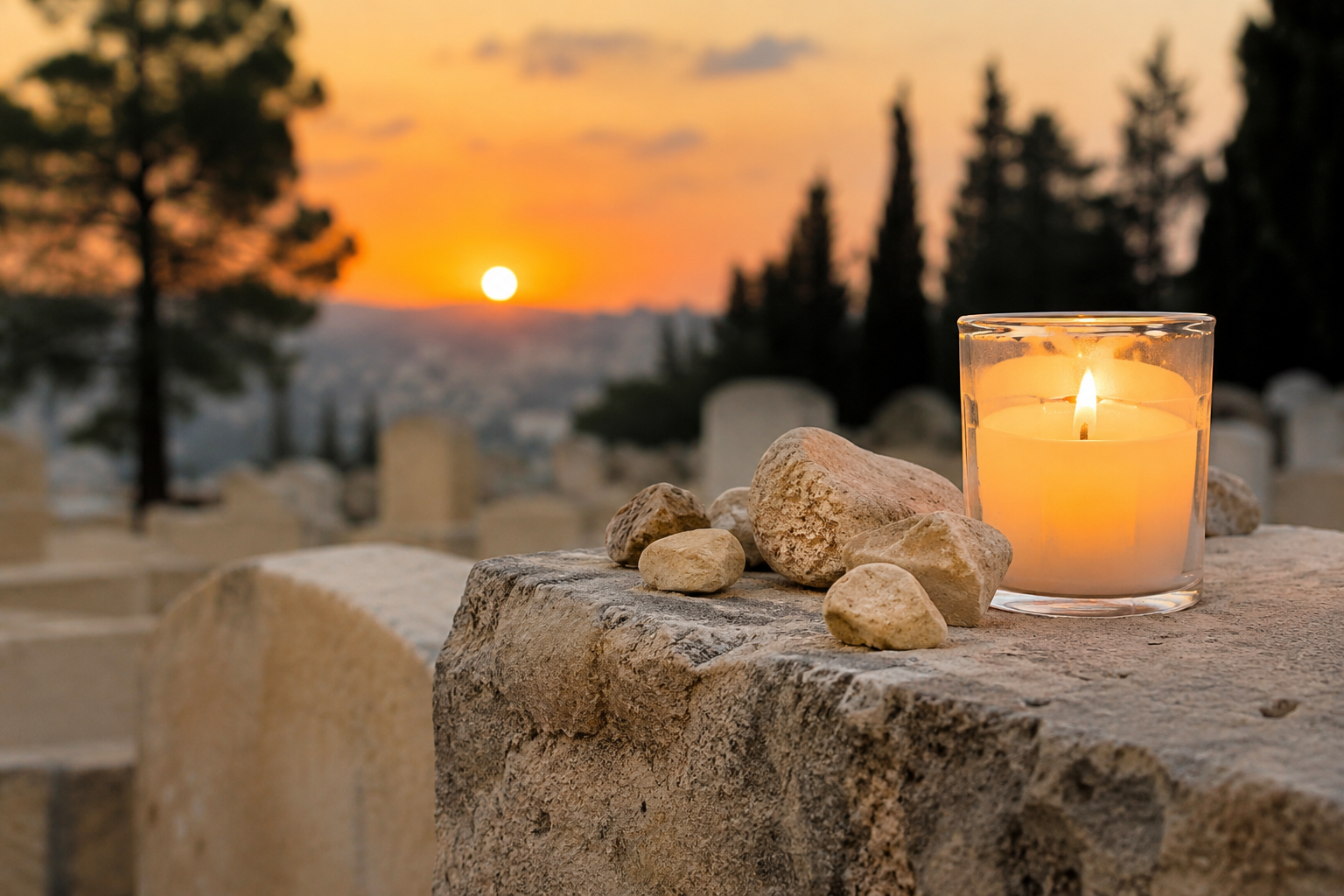
מה שתולשין עשב מקבר או נוטלין צרור ומשימין על המצבה אינו אלא משום כבוד המת להראות שהוא היה על קברו -The purpose of placing grass or a small stone on the tombstone is to honor the deceased by showing that someone visited his grave.
This explanation is brought by the Eliyah Rabbah (O.H. 224:7), Be’er Hetev (224:8), and Kaf HaHaim (581:92). When other people see the stones, they know that the deceased has not been forgotten and that people still come to visit his grave.
2. Protecting Against Forgetting Torah — Yosef Ometz
The Gemara (Horayot 13b) teaches that reading the writing on a tombstone is one of the things that can cause a person to forget his Torah learning.
Rabbi Yosef Yuzpa Hahn, in Yosef Ometz (p. 273), records a custom of placing a stone on the tombstone to protect against this concern. One explanation is that the stone covers part of the writing, preventing the person from reading the entire inscription. This explanation is discussed by later poskim, including Rivevot Efraim (8:51).
3. Inviting the Neshama to the Grave — Rabbi Salman Mutzafi
A particularly interesting explanation appears in Siftei Tzaddikim (p. 22), associated with the Sephardic mekubal Rabbi Salman Mutzafi.
According to this kabbalistic explanation, when someone arrives at the kever, he places a small stone on the tombstone as a sign inviting a spark of the deceased’s neshama to descend and rest upon the stone, which serves symbolically as a chair. When the visitor finishes praying, he should remove the stone before leaving. This symbolizes that the neshama should return to its spiritual place. (This would contradict the Maharash’s practice to specifically leave the stone on the grave.)
Awareness During the First Twelve Months
The Gemara (Shabbat 152b) states: “כל שנים עשר חדש גופו קיים ונשמתו עולה ויורדת.” – During the first twelve months, the body remains and the soul ascends and descends. After twelve months, the body’s condition changes, and the soul no longer maintains the same relationship with it. Interestedly enough, according to the opinion that the dead is aware till his body decomposes, it actually takes about a year for the body to decompose if he’s not buried in a coffin, as Jewish law requires the dead to be buried wrapped in a Talit, not a coffin.
This indicates a special connection between the soul and body during the first year. However, it does not establish that the soul stops knowing what happens in this world afterward. Indeed, Kalev went to the graves of the Avot hundreds of years after their deaths, and the Zohar describes the continuing involvement of the souls of tzaddikim long after burial.
We should all be zoche to see Tehiyat HaMetim and Mashiah Tzidkenu, bimhera beyamenu, amen.