 Print this Article
HaRav Yishai Natan –
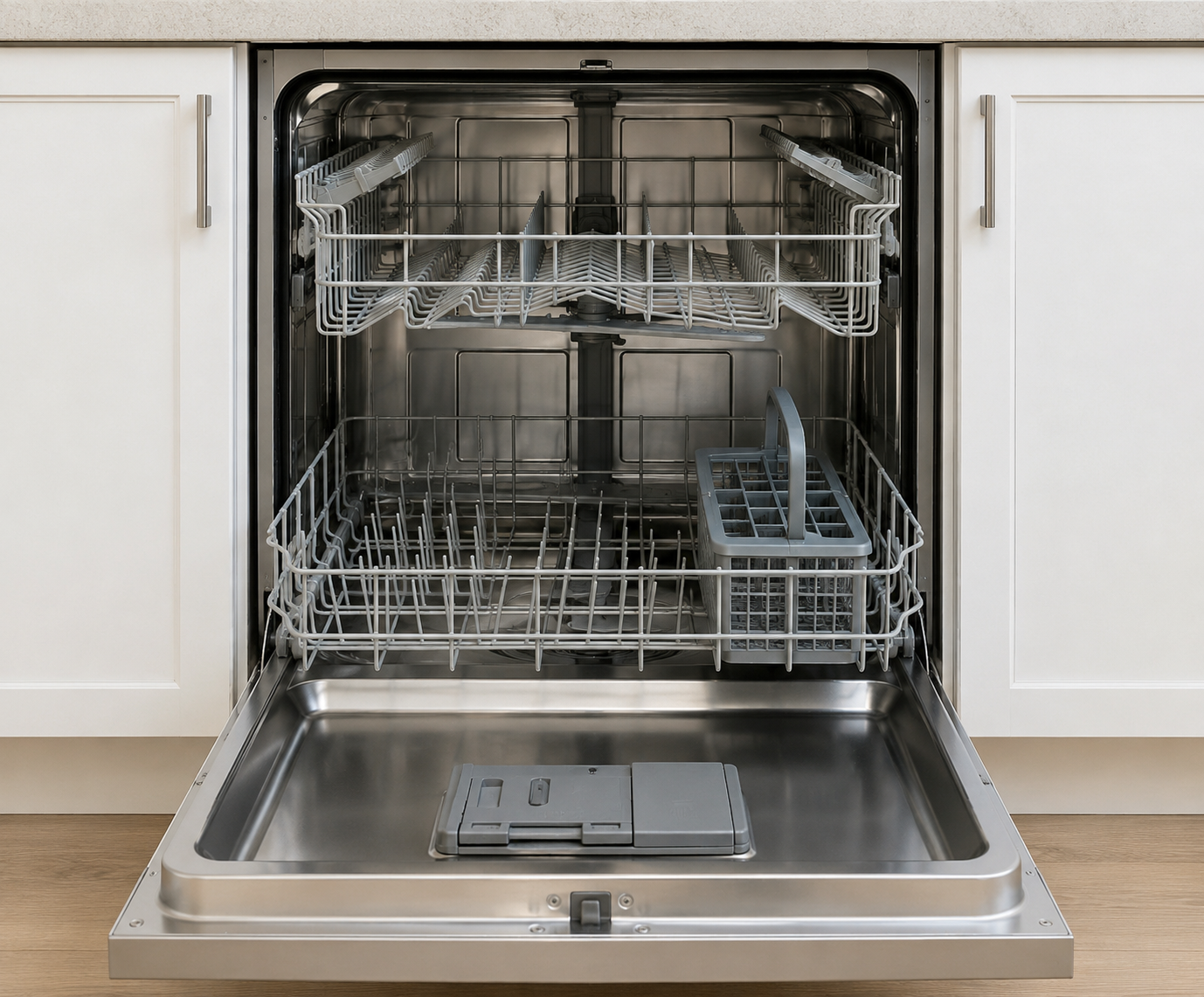
This week’s Parashah discusses the war against Midyan. After the battle, the pasuk says, “Kol davar asher yavo ba’esh ta’aviru ba’esh,” teaching the laws of libun and hakhsharat keilim because of the beliut (taste) that got absorbed in the kelim. That leads us to a practical question: Are you allowed to use the same dishwasher for meat and milk?
For Sephardim, using the dishwasher for meat and milk one after the other is generally not much of a discussion. The real question is whether meat and milk dishes may be washed together in the same load. Imagine placing meat dishes with leftover hamin or other meat residue together with macaroni and cheese dishes in the same dishwasher. Is that permitted?
How a Dishwasher Works
Before discussing the halachah, we first need to understand how a dishwasher operates. Knowing the halachah alone is not enough if you do not understand how the machine works.
Although modern dishwashers vary, they generally operate in four stages:
- Pre-wash: Cold water fills the bottom of the dishwasher. It sprays the dishes for about 20–30 seconds to remove loose food particles, and then the dirty water and residue drains out.
- Main wash: Hot water fills the dishwasher, the detergent compartment opens, and soap is released. Water then is sprayed everywhere and recycled. This cycle usually lasts 20–30 minutes.
- Final rinse: Very hot water rinses the now-clean dishes to ensure everything is thoroughly cleaned.
- Drying: The heating element turns on and dries the dishes.
There are also two types of dishwashers regarding the heating coil. Some have the coil directly on the bottom, while others have it two or three inches above the bottom. For our discussion, we will first assume the more problematic case, where the coil is on the bottom.
When the water fills the bottom and the coil heats it, the water becomes a keli rishon. If it were only a keli sheni, there would be far fewer halachic concerns. Therefore, throughout most of this discussion, we will assume the dishwasher has the heating coil on the bottom.
Does the Water Become a Keli Rishon?
One might argue that the water coming from the home’s water heater was already hot. However, once that water is poured into the dishwasher, it becomes a keli sheni. If the dishwasher simply sprayed that water, it would only be irui keli sheni, which according to Maran presents no problem, although some Ashkenazim are mahmir. Since we are looking at the most stringent case, we assume the heating element reheats the water after it enters the dishwasher, making it a true keli rishon.
The heating element remains on throughout the cycle to maintain a constant temperature for 20–30 minutes.
The First Possible Problem: Cooking Meat and Milk
During the pre-wash, most food particles are removed, but not all of them. Some remain at the bottom, and more residue falls there during the main wash.
Now you have meat and milk residue sitting together in a keli rishon. At first glance, this appears to be a problem of cooking meat and milk. Even if you never eat the mixture or benefit from it, there is an independent prohibition against cooking meat and milk together.
However, many argue that this is not considered normal cooking (derech bishul). The purpose of the dishwasher is cleaning, not cooking. Similarly, if someone pours hot milk into a garbage can that contains meat scraps, that is considered disposal rather than cooking.
According to this approach, the prohibition of bishul basar be’halav does not apply.
The Concern of Hanan
Even if this is not considered prohibited cooking, the meat and milk are still being heated together. Perhaps the rule of hanan (hatiha na’aseh nevelah) applies, causing the entire body of water to become prohibited as basar be’halav, which would then be sprayed over all the dishes.
The response is that very little meat and milk residue remains after the cold pre-wash. Most of the remaining residue is neither meat nor milk, rather potatoes and other foods. Furthermore, only one of the two would need to become batel. In practice, there is almost always shishim against the small amount of meat or milk residue. If there is shishim, the water never becomes prohibited through hanan.
Once the meat or milk is already batel, there is also no more prohibition of cooking them together.
Does Hot Water Transfer Beliut?
Another concern is that hot water sprays milk residue onto a meat dish. Perhaps the hot spray removes the absorbed milk taste and forces it into the meat utensil.
However, Maran holds that irui cannot both extract absorbed flavor and simultaneously force that flavor into another utensil. It can only perform one action. Therefore, hot water cannot remove milk flavor and immediately transfer it into a meat utensil.
In addition, it is not even certain that the spray qualifies as irui, since all of the water remains connected to the reservoir below. It may simply be considered one body of water in a keli rishon, where any absorbed flavor would still be batel in shishim.
Steam and Nat Bar Nat
A later concern is the steam (ze’ah) that fills the dishwasher after the dishes are already clean.
At this stage, the food residue is gone, but the utensils still contain absorbed flavor (beliot). Since there may not be shishim against those absorbed flavors, perhaps the steam transfers taste between meat and milk utensils.
Here we apply the rule of nat bar nat, an area where Sephardim are much more lenient than Ashkenazim.
Milk first gives flavor to the utensil. That utensil then gives flavor to the water or steam. Once the flavor has been transferred twice, it no longer has the strength to prohibit another utensil. Therefore, even if the dishwasher fills with steam, the transferred flavor remains permitted.
Maran discusses placing meat and milk utensils into the same pot of hot water and rules that this is permitted because of nat bar nat.
Is There a Problem of Intentionally Nullifying a Prohibition?
Even if everything becomes batel, perhaps placing the dishes together intentionally violates the prohibition of mevatel issur le’hat’hilah.
The Bet Yosef (YD 94) cites the Ran who explains that this prohibition applies only when one’s intention is to nullify the prohibition. Here, the intention is simply to wash dishes, not to nullify any prohibited mixture.
The same reasoning is applied in other halachic discussions, such as making smoothies where insects are unintentionally blended. Since the purpose is to make a smoothie rather than to nullify the insects, it is not considered mevatel issur le’hat’hilah.
The Main Reason: Soap
We have not yet reached Hacham Ovadia’s primary reason for permitting meat and milk dishes together.
During the main wash, detergent is released into the water. Soap renders the mixture pagum. Once the water is pagum, it can no longer prohibit anything.
Hotels often rely on this concept when kashering equipment that was used within the previous 24 hours. Instead of waiting an entire day, they sometimes add a cleaning agent to the boiling water, making the absorbed flavor pagum.
In Yabia Omer (10:4), Hacham Ovadia Yosef rules that because of the detergent, everything during the main wash remains permitted. Even though the final rinse contains no soap, nat bar nat still applies.
Toward the end of the teshuvah, Hacham Ovadia writes that his son, Rabbi Yitzhak Yosef, independently reached the same conclusion. It is beautiful that after presenting the lengthy discussion, he notes that his son also ruled the same way.
The Disagreement About Soap
Many authorities disagree with relying on soap. Although this approach follows Maran, the Shach (95:15), the Taz (95:21), and even some Sephardic poskim argue that this concept was introduced by the Bet Yosef rather than being found explicitly in the Gemara. The Bet Yosef even writes “nir’eh li,” “it appears to me,” which is unusual for him.
Nevertheless, Sephardim accept the ruling of Maran.
Hacham Ovadia argues that even the Shah and the Taz would agree regarding today’s detergents because they are even more effective.
Others argue the exact opposite. They claim modern detergents are milder than those used in earlier generations.
The Practical Recommendation
Both Hacham Ovadia and Rabbi Yitzhak Yosef conclude that although washing meat and milk dishes together is technically permitted, it is preferable to wash them one after the other (zeh ahar zeh). This recommendation may be because of differing opinions regarding soap or because of other possible concerns.
The Or LeTzion, recorded by his students, writes that washing meat and milk dishes together is not acceptable, while washing them one after the other is permitted. He also recommends separate racks.
This recommendation seems influenced by the approach of Rav Moshe Feinstein in Igrot Moshe (YD 2:28), who was concerned that actual food residue might remain on the racks.
Modern Dishwashers
Everything discussed until now assumes the heating coil is on the bottom.
Many newer dishwashers have several pre-wash cycles before the detergent is released. The first pre-wash uses water that is still cold because it has been sitting in the home’s pipes. Later pre-wash cycles use genuinely hot water from the water heater, yet detergent has still not been added. In those dishwashers, Hacham Ovadia’s primary reason of pagum soap would not yet apply.
If someone nevertheless wishes to wash meat and milk dishes together, they should pour liquid detergent directly onto the bottom of the dishwasher before starting the cycle. That way, even the earliest rinse water will make everything pagum.
Dishwashers With Raised Heating Coils
Now let us consider the second type of dishwasher, where the heating coil is above the bottom.
Here, water enters from the water heater and collects in the shallow reservoir beneath the coil. Once the water leaves the plumbing and enters the dishwasher, even if it was extremely hot, it immediately becomes a keli sheni.
The spray arms then circulate only keli sheni water, or more accurately, irui keli sheni. According to Maran, keli sheni cannot prohibit anything, even without soap.
The purpose of the raised heating element is simply to maintain the water’s temperature. Every time the water touches the heating element, it briefly becomes keli rishon, but as soon as it falls back into the reservoir, it again becomes keli sheni. The entire cycle repeats itself continuously.
Technically, such a dishwasher would present no halachic concerns, and washing meat and milk dishes together would be permissible.
Nevertheless, today, Baruch Hashem, many homes have two dishwashers. Therefore, it is still preferable to be mahmir and keep separate dishwashers for meat and milk.