 Print this Article
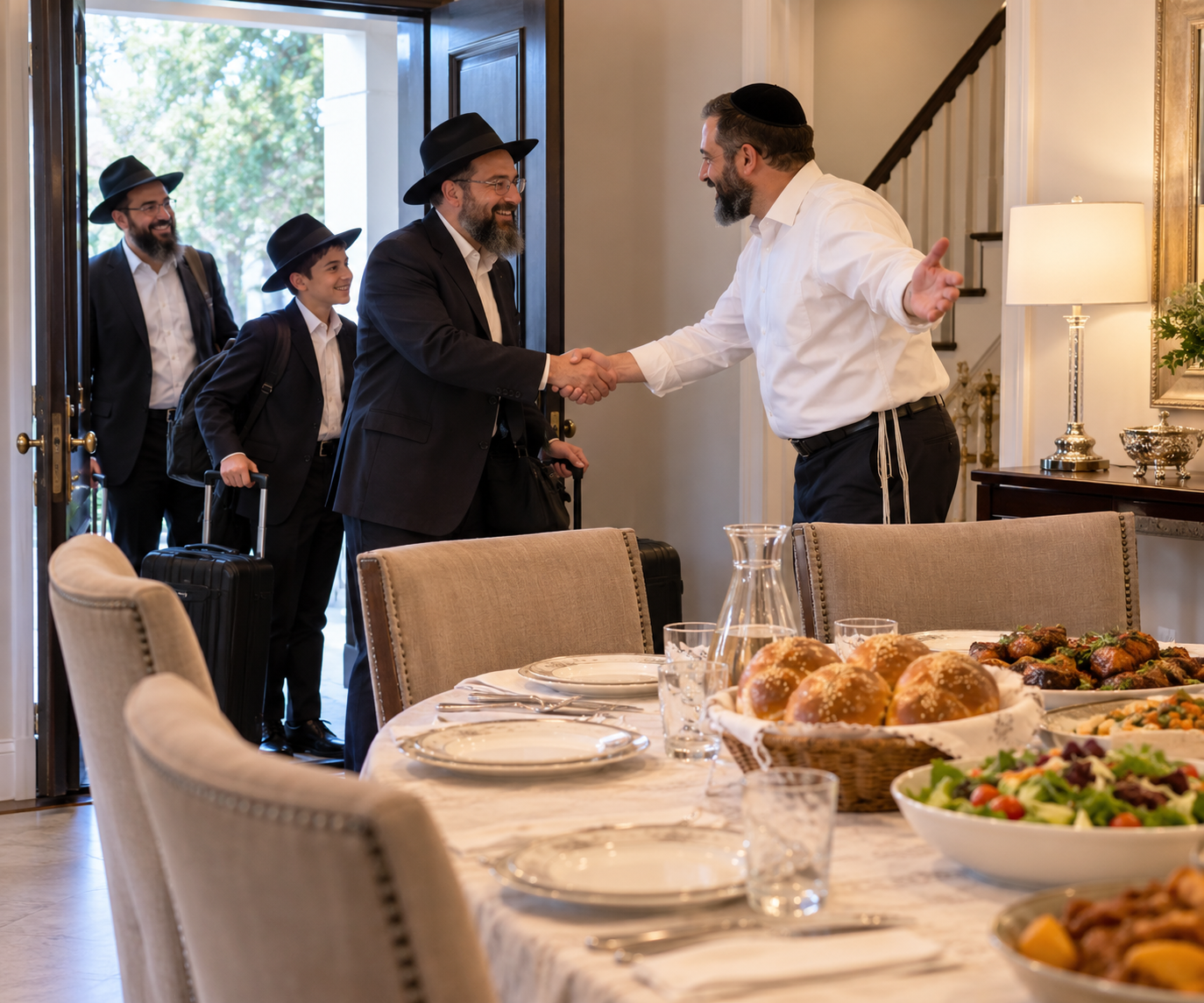
Rabbi Yishai Natan –
In Parashat Vayera, we learn the great mitzvah of hachnasat orhim from Avraham Avinu. Our Sages tell us that Avraham had a tent with openings on all four sides, so travelers approaching from any direction could easily enter. He placed himself where travelers passed, looking for opportunities to invite them into his home.
We also learn about this mitzvah from the Ishah HaShunamit, who prepared a special room for Elisha HaNavi, providing him with a bed, table, chair, and lamp.
Interestingly, the Shulhan Aruch does not have a dedicated section explaining all the halachot of hachnasat orhim. Although certain laws appear in different places, much of the mitzvah is discussed in other sefarim. Two particularly important works are Ahavat Hesed by the Hafetz Haim, especially Part 3, chapters 1–2, and Kaf HaHaim by Rav Haim Palagi, simanim 5–6. Rav Haim Palagi discusses the mitzvah at great length, including many practical instructions for hosts and guests.
1. The Great Reward of Hachnasat Orhim
The Gemara (Shabbat 127a) includes hachnasat orhim among the mitzvot whose fruits a person enjoys in this world while the principal reward remains for the World to Come:
אלו דברים שאדם אוכל פירותיהן בעולם הזה והקרן קיימת לו לעולם הבא
גדולה הכנסת אורחים מהקבלת פני שכינה
Welcoming guests is greater than receiving the Shechinah. We learn this from Avraham Avinu, who asked Hashem to wait while he attended to his guests.
Rav Haim Palagi (Kaf HaHaim 5:16) quotes the Sefer HaBrit, who lamented that in his time very few people practiced true hachnasat orhim. He described it as a mitzvah fulfilled by only one in a thousand.
Baruch Hashem, nowadays we see many people making tremendous efforts to host guests. Some families even build special guest bedrooms or separate accommodations in their basements.
There is also a special reward for hosting talmidei hachamim. The Ishah HaShunamit was blessed with a son after providing hospitality to Elisha HaNavi. Rav Haim Palagi also discusses teachings connecting the hospitality shown to Yaakov Avinu and Moshe Rabbenu by Lavan and Yitro with blessings in their families.
2. Is Hachnasat Orhim a Mitzvah Min HaTorah?
The first question is whether hachnasat orhim is an actual Torah obligation. There are two general mitzvot through which we can understand this obligation.
A. Ve’ahavta Lere’acha Kamocha: The Torah commands us, ואהבת לרעך כמוך. Just as we want our own needs taken care of, we must care about the needs of others. The Rambam (Hilchot Avel 14:1) includes hachnasat orhim among the mitzvot of gemilut hasadim, explaining that these obligations are included in ve’ahavta lere’acha kamocha.
B. Vehalachta Bidrachav: The Torah also commands us to follow the ways of Hashem. We see that Hashem Himself came to visit Avraham when he was recovering from his berit milah. We also see how important hospitality was to Hashem, who arranged for guests to come to Avraham.
3. Is Hachnasat Orhim Fulfilled with Rich People or Poor People?
One of the most interesting discussions is who qualifies for this mitzvah. One might assume that hachnasat orhim applies specifically to poor people. After all, a wealthy person has his own house and food. Why does he need someone else to invite him into his home? However, we find several opinions among the poskim.
A. Maharil (minhagim p. 626) — Wealthy and Respected Guests: The Maharil takes a surprising approach. He distinguishes between poor guests, for whom providing food is primarily tzedakah, and wealthy or respected guests, whom the host welcomes and honors. He brings a proof from Avraham Avinu, who prepared three tongues with mustard for his visitors (Bava Metzia 86b). This was expensive, high-quality food. The emphasis is on the special honor Avraham showed his guests. According to this approach, the unique mitzvah of hachnasat orhim is closely connected to the kavod given to guests, rather than merely supplying food to someone who is hungry.
B. Minhat Yaakov — The Opposite Proof from Avraham: The Minhat Yaakov challenges this reasoning. Avraham thought the three visitors were ordinary Arabs. He did not know that they were angels, and they did not appear to be particularly important people. Nevertheless, Avraham honored them tremendously. This suggests that the mitzvah certainly does not depend on the guests being wealthy or respected.
C. Shelah — Poor Guests Are Preferable: The Shelah discusses the special importance of inviting poor people. Although one fulfills hachnasat orhim with wealthy guests, there is an additional advantage to inviting poor people. When hosting a poor guest, one can fulfill two mitzvot: hachnasat orhim and tzedakah.
We find a similar idea in Pirkei Avot (1:5): יהי ביתך פתוח לרוחה ויהיו עניים בני ביתך. Your home should be open generously, and poor people should be members of your household. First, the Mishnah speaks about opening our homes to guests. Then it specifically mentions poor people, emphasizing the importance of giving them a place in our homes.
Ahavat Hesed — Even Wealthy Guests: The Hafetz Haim (Ahavat Hesed, Part 3, chapter 1) explains that hachnasat orhim applies even to wealthy guests. Even when they do not need our financial help, welcoming them warmly, serving them, and honoring them is a mitzvah. His wording emphasizes that even wealthy guests qualify, indicating that poor guests certainly qualify as well.
Pele Yoetz — The Greater the Need, the Greater the Hesed: The Pele Yoetz (entry Orhim) emphasizes that the value of an act of hesed increases according to the recipient’s needs and difficulties. Therefore, there is a special advantage to welcoming someone who genuinely needs assistance.
A Possible Explanation of the Maharil: Perhaps we can suggest that even the Maharil would agree that a person fulfills hachnasat orhim by honoring poor guests in the same way he would honor wealthy guests. Why does the Maharil mention the expensive food Avraham served? Perhaps the point is not necessarily that the guests themselves were wealthy. Rather, the mitzvah involves treating guests with exceptional honor. When a poor person enters someone’s home, the host might simply give him some bread or another basic necessity. The poor person will probably be grateful for whatever he receives. But when a wealthy or respected person comes, the host will generally prepare his best food and give him tremendous honor. Perhaps this is what the Maharil means. If someone invites a poor person and treats him with the same honor he would give a wealthy, respected guest, perhaps even the Maharil would agree that he fulfills hachnasat orhim.
4. Does Hachnasat Orhim Apply to Children and People Living in Your Home?
The mitzvah is not limited to adults. For example, suppose a family goes out of town and leaves their children with another family. The family taking care of those children can fulfill hachnasat orhim.
Similarly, someone who takes a child or teenager into his home for an extended period, allowing him to live there, eat there, and sleep there, can be performing this mitzvah every day. This is a tremendous opportunity for hesed. The same principle can apply to an older person living in someone’s home, depending on the circumstances.
5. Does Inviting a Neighbor Count as Hachnasat Orhim?
Suppose I invite my neighbor for Shabbat lunch. He lives across the street, has his own house, and has plenty of food. Do I fulfill hachnasat orhim?
A. Rema — O.H. 333:1: The Gemara (Shabbat 126b–127a) discusses moving stored items on Shabbat to make room for guests. Although excessive exertion on Shabbat is generally restricted, Hazal permitted certain forms of clearing space for guests. The Rema (O.H. 333:1), citing the Terumat HaDeshen (siman 72), distinguishes between actual guests and friends invited for an ordinary meal:
אבל כשזימן חבירו לסעוד אצלו לא מקרי אורחים ואינה סעודת מצוה רק סעודת רשות – Inviting a regular friend for a meal does not have the special status of orhim for this halacha.
B. Kaf HaHaim — O.H. 333:11: quotes the Shulhan Aruch HaRav:
ואינם נקראים אורחים אלא שבאו מעיר אחרת – Guests are people who have arrived from another city. According to this definition, someone who lives in the same city would not qualify for the special Shabbat allowance.
C. Minhat Yaakov — The Minhat Yaakov, as cited in Pithei Teshuvah (Y.D. 69:11), disagrees with the restrictive approach concerning invited friends. Just because for moving muktzeh they must be guests from out of town, but for the mitzva of Hachnasar Orhim it is for everyone.
D. Pithei Teshuvah — Y.D. 69:11: The Pithei Teshuvah brings the disagreement concerning who qualifies as an ore’ah for the relevant leniency, but does not state his opinion who to follow.
E. When Everyone Would Agree: Suppose your neighbor has a power outage, or his family is locked out of their house. You invite them to stay in your home, provide them with food, and give them a place to sleep. Everyone will agree you did the mitzva.
F. Must the Guest Be Invited? Another interesting question is whether a person must actively invite someone to fulfill the mitzvah.
Rav Haim ben Betzalel, the brother of the Maharal of Prague, discusses the importance of inviting guests in Sefer HaHaim. A distinction has been suggested between a host who actively seeks out guests, as Avraham did, and guests who come into his home on their own. According to this approach, actively inviting a person is an important part of the mitzvah. However, the claim that an uninvited guest never qualifies requires further examination of the original text.
6. Can a Person Fulfill Hachnasat Orhim by Giving Someone a Ride?
Does hachnasat orhim require a house, or can it be fulfilled by welcoming someone into a car?
A. Hazon Ish — Even in a Car: The Ma’aseh Ish (volume 5, p. 138) reports in the name of the Hazon Ish that giving someone a ride can fulfill hachnasat orhim. The person needs transportation, and by welcoming him into your car and bringing him to his destination, you are providing hospitality.
B. Rav Haim Kanievsky — Hesed, but Not Hachnasat Orhim: In Simhat Mordechai, an opinion is brought in the name of Rav Haim Kanievsky that giving a ride is certainly hesed, but not necessarily the specific mitzvah of hachnasat orhim. According to this approach, hachnasat orhim requires something more connected to providing food or lodging.
C. The Steipler — Giving Food During the Ride: A statement is also brought in the name of the Steipler that if someone gives a person a ride and provides him with food during the trip, he can fulfill hachnasat orhim. This suggests that lodging is not necessarily required. Providing food can also qualify.
7. Can a Poor Person Without a Home Fulfill Hachnasat Orhim?
One might assume that a person who does not own a house or have enough money cannot fulfill this mitzvah. However, Kaf HaHaim Palagi (siman 5) explains that even someone without the means to host guests can participate in hachnasat orhim. When travelers arrive in town, he can go out to greet them, ask whether they need anything, and help arrange food or a place to sleep. He can speak to other people on their behalf and find someone willing to host them.
8. Hosting People Who Speak Lashon Hara or Have a Negative Influence
Another question is whether a person fulfills hachnasat orhim by inviting someone who may have a negative influence on the household.
A. Inviting Reshaim: There is a general principle: לעולם אל ירבה אדם רעים בתוך ביתו – One should not bring harmful influences into one’s home. The Pele Yoetz discusses the importance of being careful about the people we invite. He applies the idea of אל תהי צדיק הרבה. A person should not become so determined to perform one mitzvah that he ignores the spiritual harm that may result.
B. Guests Who Speak Lashon Hara: What if the guests are otherwise good people, but you know they will probably spend the meal speaking lashon hara? There is a discussion whether one still fulfills hachnasat orhim in these circumstances. Even according to those who maintain that the mitzvah is fulfilled, the host may violate prohibitions by listening to or participating in lashon hara.
9. What Is More Important — Food or a Place to Sleep?
Rav Haim Palagi discusses this question at the beginning of Kaf HaHaim (5:1). The Ishah HaShunamit told her husband to prepare a room for Elisha HaNavi:
נעשה נא עלית קיר קטנה ונשים לו שם מטה ושלחן וכסא ומנורה – They provided a bed, table, chair, and lamp.
Rav Haim Palagi brings the Zohar, which asks why the bed is mentioned before the table. The answer is that a traveler who arrives after a tiring journey may need a comfortable place to sleep even more than he needs food. Therefore, Rav Haim Palagi emphasizes that providing lodging is an especially important part of hachnasat orhim.
10. The Importance of the Wife’s Agreement
Rav Haim Palagi discusses the role of the wife at length in Kaf HaHaim (5:1). The Gemara (Bava Metzia 87a) teaches: אשה עיניה צרה באורחים יותר מן האיש – A woman may be more concerned than her husband about the burden of having guests.
Rav Haim Palagi explains that the wife plays a central role in the success of hachnasat orhim. After all, the guests are entering her home as well. Hosting may involve extra cooking, preparation, cleaning, and inconvenience. Therefore, the husband must be careful not to impose guests on his wife in a way that causes her distress.
Lot’s Wife: We find that Lot’s wife was unwilling to provide salt for the guests. The Midrash connects her refusal to the punishment of being turned into a pillar of salt. The Ishah HaShunamit: On the other hand, the Ishah HaShunamit prepared a special room for Elisha HaNavi. In the merit of her kindness, she was blessed with a son.
Rav Haim Palagi emphasizes that the mitzvah depends greatly on the wife and her willingness to welcome guests. When she participates willingly and happily, the entire atmosphere of the home changes.
11. Do Not Embarrass Guests with Questions
Rav Haim Palagi warns that a host should not ask a guest difficult Torah questions unless he knows the guest is capable of answering them. Otherwise, the guest may become embarrassed in front of others. The purpose of hospitality is to make the guest feel honored and comfortable, not to test his knowledge.
There is also a lesson from the parashah concerning what a person should ask a traveler. When someone arrives, the first concern should be whether he needs food, drink, or rest. The host should not begin by asking unnecessary personal questions. First take care of the guest’s needs. Other conversation can follow afterward.
12. Never Show Anger in Front of Guests
Rav Haim Palagi brings from the Arizal the importance of avoiding anger during a meal. This is especially important when guests are present. If the host becomes angry about something, the guests may assume that he regrets inviting them or resents the amount of food they are eating. Even if his anger has nothing to do with them, they feel you’re angry at them. Similarly, suppose something goes missing during the meal. The host should not make a big scene about the missing item, because the guests might think he suspects them of stealing it.
13. Receive Guests with Sever Panim Yafot
One of the most important parts of the mitzvah is welcoming guests with a pleasant expression. The Maharil and other authorities emphasize the importance of honoring guests and making them feel welcome. A person might serve an expensive meal, but if he looks upset or annoyed, the guests will not enjoy themselves. On the other hand, a host who serves a simple meal with a warm smile may be performing a greater act of hesed.
14. How Much Must Someone Spend on Guests?
Does hachnasat orhim require serving expensive meat, wine, and other elaborate foods?
Rav Haim Palagi (Kaf HaHaim 5:15) explains that a person is not obligated to provide food beyond his financial means. He brings the teaching that a host should give according to what he can afford.
The Sefer Hasidim (siman 56) similarly emphasizes that serving simple food happily is better than serving expensive food with an unpleasant attitude: טוב ארוחת ירק בשמחת פנים משור אבוס ופנים זועפים – A modest meal with a cheerful expression is better than an elaborate meal served with anger.
However, someone who has the financial means to honor guests generously should certainly consider doing so. This connects to the earlier discussion of the Maharil, who emphasizes honoring guests in an exceptional way.
Hiddur Mitzvah: Just as other mitzvot have the concept of hiddur mitzvah, there is room to perform hachnasat orhim in a more beautiful way. Providing comfortable accommodations, good food, and thoughtful attention can all contribute to honoring the mitzvah. However, one must distinguish between genuine hiddur mitzvah and spending money simply to impress others.
15. Personally Serving the Guests
The Torah describes how Avraham personally ran to prepare food for his visitors: ואל הבקר רץ אברהם – He did not simply tell his servants to do everything. Even though Avraham was a wealthy and respected person, he personally involved himself in serving the guests. This teaches that the host should not feel that serving guests is beneath his dignity. In fact, doing the mitzvah personally adds to its importance.
At the same time, Avraham involved Yishmael in preparing the food. This teaches us that hachnasat orhim is also an opportunity to educate our children in hesed. When children help prepare bedrooms, set the table, or serve guests, they learn firsthand how to welcome others. (Ahavat Hesed, Part 3, chapter 2)
16. Make Guests Feel That They Are Not a Burden
Rav Haim Palagi emphasizes that when guests enter the home, the host should show that he is happily taking care of them. He should make sure they see that their presence is welcome. If the host acts as though everything is difficult and inconvenient, the guests may feel that they are imposing.
17. The Custom in Izmir
Rav Haim Palagi describes a beautiful custom in his city of Izmir.
When a visitor arrived and was staying at someone’s home, local talmidei hachamim would come to visit. First, they would praise the host in front of his guests, showing appreciation for the mitzvah he was performing. Then they would ask the visitor why he had come to town. The purpose was not curiosity. Rather, they wanted to know whether he needed assistance. Perhaps he had come for medical treatment and needed someone to pray for him. Perhaps he needed financial help or assistance with some other matter.
18. The Original Takanah of Birkat HaOreach
The Gemara (Berachot 46a) teaches: בעל הבית בוצע ואורח מברך – The host recites HaMotzi, while the guest leads Birkat HaMazon.
Why should the guest lead Birkat HaMazon? The Gemara answers: ואורח מברך כדי שיברך לבעל הבית – The guest leads Birkat HaMazon in order to bless the host. This is the source of Birkat HaOreach.
Maran, in Shulhan Aruch (O.H. 201:1), rules that the guest should be given the honor of leading Birkat HaMazon, even when the host is a greater talmid hacham.
However, Maran also writes that the host may waive this arrangement and lead Birkat HaMazon himself.
Why Was the Guest Given the Zimun?
Normally, leading the zimun is an honor. The host has a special connection to the meal because it is his home and his food. Why should he give this honor to the guest? The answer is that in the time of the Gemara, the person leading Birkat HaMazon would recite the entire blessing aloud, while everyone else listened and fulfilled their obligation through him.
Therefore, if the host led Birkat HaMazon, the guest would not be the one saying Birkat HaOreach. Hazal wanted the host to receive the guest’s blessing, so they established that the guest should lead.
Nowadays, Everyone Says Birkat HaMazon Individually
Today, the common practice is for everyone to recite Birkat HaMazon individually. Even when one person leads the zimun, the others recite Birkat HaMazon themselves.
The reason is that it is difficult to maintain the concentration required to fulfill Birkat HaMazon through listening to someone else from beginning to end.
Therefore, the original reason for giving the guest the zimun may no longer apply in the same way. Every guest can now recite Birkat HaOreach in his own Birkat HaMazon.
Must Every Guest Say Birkat HaOreach?
Originally, one guest recited Birkat HaMazon for everyone and included Birkat HaOreach.
But nowadays, when everyone says Birkat HaMazon individually, is every guest obligated to recite Birkat HaOreach? Or was the original takkanah only that the guest leading the zimun should say it?
A. Aruch HaShulchan — Every Guest Is Obligated: Aruch HaShulchan (O.H. 201:3) writes explicitly: ופשוט הוא דעכשיו שכל אחד מברך ברכת המזון מחויב כל אורח לברך ברכה זו – Since everyone now recites Birkat HaMazon individually, every guest is obligated to say Birkat HaOreach. Even if someone else leads the zimun, every guest must personally bless the host.
B. Kaf HaHaim — Every Guest Can Bless the Host: Kaf HaHaim (O.H. 201:18–19), by Rav Yaakov Haim Sofer, explains that nowadays, when everyone recites Birkat HaMazon individually, each person can bless the host.
His language is: יכול כל אחד לברך – Every person can recite the blessing.
Notice the difference in wording. The Aruch HaShulchan explicitly says mechuyav, obligated. The Kaf HaHaim uses the language yachol, meaning that each person can say it.