 Print this Article
HaRav Yishai Natan –
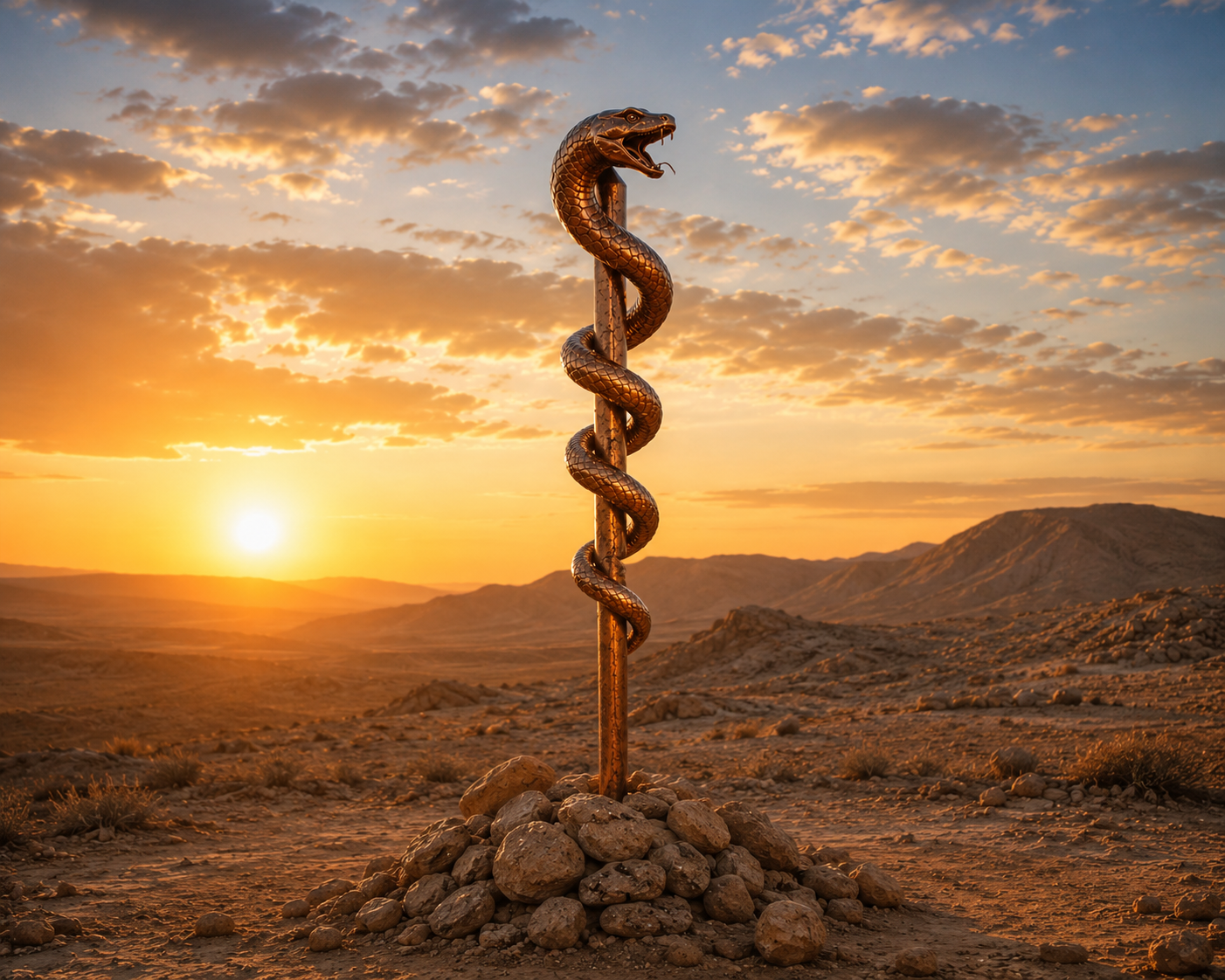
Nehash HaNehoshet
This week is a double parashah. Since we are a week behind Eretz Yisrael, we catch up by reading two parashiyot. In Parashat Hukat, the pasuk says that Mosheh Rabbenu made a copper snake, the Nehash Nehoshet. Whoever was bitten would look at it and be healed.
This raises an obvious question: How was Mosheh Rabbenu allowed to make the figure of a snake? The pasuk says in Shemot 20:20, “Lo ta’asun itti elohei kesef, velohei zahav.” The Gemara explains that this includes certain images that may not be made, even when they are not being made as idols.
Images That Are Forbidden
The Gemara says that one may not make images of the heavenly servants, such as Ofanim, Serafim, Hayot HaKodesh, and Malachei HaSharet. One may also not make the four faces of the Merkavah together: a lion, an ox, an eagle, and a man. However, the image of a person is forbidden even by itself.
The Gemara also teaches that one may not make images of the sun, moon, or stars. Additionally, one may not replicate the vessels of the Bet HaMikdash, such as the Menorah.
The Rambam, in Mitzvat Lo Ta’aseh 4, explains that the reason for this issur is to distance us from Avodah Zarah. Since these types of images were commonly used for idol worship, the Torah prohibited making them.
Making Versus Owning
The issur min haTorah is to make these forbidden images. Simply owning them is not forbidden min haTorah. However, Hazal made an issur de’Rabbanan to own them as well, because of Hashad—suspicion.
There are two explanations of this Hashad. Tosafot explains that people may suspect that the owner worships the image. The Rosh explains differently: people may suspect that the owner made the image himself, which would be an issur de’Oraita.
Therefore, making such images is an issur min haTorah, while owning them is an issur de’Rabbanan because of Hashad.
Making Images of Animals
Based on what we explained, there is generally no problem making the image of an animal. Animals are not included in the main categories that the Gemara lists as forbidden images. Although people in Mitzrayim worshiped sheep, animals in general are not the type of image that the Torah prohibited making.
Earlier, we mentioned that one may not make the lion, ox, eagle, and man of the Merkavah. However, Maran rules in Shulhan Aruh, Yoreh De’ah 141:4, that this is only forbidden when all four are made together, as they appear in the Merkavah. Making one of them by itself is not included in that prohibition.
The Bah, however, is stricter. He writes that even a lion or ox alone should not be made, since they are also part of the mazalot. However, we do not rule like the Bah. The Shah argues on him, and the halachah follows Maran: these forms are only forbidden when they are made together.
The Nehash Nehoshet
Accordingly, the question of how Mosheh Rabbenu made the Nehash Nehoshet is very simple. A snake is not one of the forbidden forms listed by the Gemara. Even regarding the four faces of the Merkavah, the prohibition applies only when they are made together. Therefore, there was no prohibition for Mosheh Rabbenu to make a copper snake.
There are some Rishonim, including the Ran and the Ramban, who hold that although making animal images is not forbidden min haTorah, it is nevertheless forbidden mi’de’Rabbanan. However, even according to that opinion, Mosheh Rabbenu lived before that takkanah was enacted, so it would not apply to him.
In practice, however, we do not follow that stricter opinion. Rav Moshe Feinstein, in Igrot Moshe, Yoreh De’ah 2:55, writes that we do not rule like those Rishonim, and it is permitted to make animal figures.
Animal Images in a Bet Knesset
Even though animal figures are generally permitted, the Taz, in Yoreh De’ah 141, writes that one should not place such images in a Bet Knesset. The reason is that when people bow during tefillah, it may appear as though they are bowing toward those figures.
Therefore, while making animal figures is generally permitted, we avoid displaying them in a Bet Knesset.
Images of Human Beings
Unlike animals, making the image of a human being is much more stringent. The Gemara teaches that even the image of a person alone may not be made.
The Sefer HaHinukh (Mitzvat Lo Ta’aseh 39) explains that only Hashem has the ability to create man. By refraining from making complete human images, we acknowledge that this power belongs exclusively to Hashem.
Therefore, making a complete human figure is an issur min haTorah.
Asking a Non-Jew to Make One
If a person asks a non-Jew to manufacture a human figure, this is also prohibited because of amirah le’akum. Although there is a discussion among the Rishonim whether amirah le’akum applies only on Shabbat or to other prohibitions as well, we rule that it applies here too. Accordingly, instructing a non-Jew to make a prohibited human figure is an issur de’Rabbanan.
What Is Considered a Complete Figure?
Maran writes in Shulhan Aruh (Yoreh De’ah 141) that there is an opinion (Yesh Mi She’Omer) that the prohibition applies only to a complete figure. A head without a body, or a body without a head, is permitted.
The Shah extends this further and writes that even if the figure includes both a head and a body, but only one side is visible, such as a profile, it is also permitted.
Accordingly, the accepted ruling is that only a complete three-dimensional human figure is prohibited.
Owning Human Figures
The issur min haTorah is to make the figure. Merely owning one is only an issur de’Rabbanan because of Hashad.
Today, many poskim explain that this concern is greatly diminished. People no longer worship statues, nor do they assume that commercially manufactured figures were sculpted by their owners.
Practical Application: Trophies
A common example is sports trophies. Since they usually contain complete human figures, ordering them would appear problematic because one is asking a non-Jew to manufacture a prohibited image.
However, trophy companies generally mass-produce these figures long before any order is placed. They are simply taking finished trophies from their inventory. Therefore, one is not actually instructing them to create a new human figure specifically for him.
Receiving or owning such a trophy is even less problematic, since the concerns of Hashad are generally absent.
Sheitel Heads
A common question concerns styrofoam sheitel heads. Many people remove the nose before using them, assuming that a complete human head is prohibited.
However, Shulhan Aruh rules that the prohibition applies only to a complete human figure. A head without a body is not included in the issur.
Even regarding the issur de’Rabbanan of owning such an image, the concern of Hashad is largely absent today. People do not suspect that someone worships a styrofoam head, nor do they assume that he manufactured it himself.
Some poskim nevertheless recommend removing the nose. However, according to the accepted halachah for Sepharadim, this is unnecessary.
Maran rules that a head without a body is permitted, and therefore there is no need to remove the nose from a sheitel head.
Dolls
A more difficult question concerns dolls, since they contain a complete human form.
Rav Ovadiah Yosef discusses this in Yabia Omer (Helek 3, Yoreh De’ah 8). He writes that manufacturing complete dolls presents a greater concern than merely owning them. Someone who manufactures dolls should avoid producing complete human figures whenever possible.
Regarding ownership, however, he initially writes that although incomplete dolls present no problem, it is preferable (tov lehahmir) not to own complete dolls.
Ten years later, in Yehaveh Da’at (Helek 3, siman 64), Rav Ovadiah adopts a more lenient ruling and concludes that owning dolls is completely permitted.
First, the concern of Hashad no longer applies. No one worships dolls, and no one assumes that the owner manufactured them.
Second, dolls are toys. They are left on the floor, played with by children, and often discarded. Since they are not treated as honorable objects, there is no concern that anyone would mistake them for objects of Avodah Zarah.
He also cites support from Shulhan Aruh (Yoreh De’ah 141:3), which indicates that objects treated disrespectfully do not create the concern of Hashad.
Accordingly, Rav Ovadiah Yosef concludes that children may own dolls.
Pictures and Paintings
Until now we have discussed three-dimensional figures. What about pictures and paintings?
The Rambam (Hilhot Avodah Zarah 3:10) rules that only raised, three-dimensional images (bolet) are prohibited. Flat images are permitted.
Many Rishonim, including the Ra’avad, Ritva, Ramban, and Ran, disagree and prohibit even flat images of people. Several later poskim, including the Hakham Tzvi and the Divrei Malkiel, follow this opinion.
However, Sepharadim follow Maran in Shulhan Aruh (Yoreh De’ah 141:4), who rules like the Rambam that flat pictures are permitted.
Opinions That Are More Stringent
The Ben Ish Hai (Parashat Masei, ot 10) writes that if the picture is incomplete there is no concern. If it is a complete image, he recommends stringency as a middat hasidut, not as an actual prohibition.
Likewise, Hakham Ovadiah Hedaya, in Yaskil Avdi, was stringent regarding photographs. It is well known that he avoided being photographed because of this view.
The Ruling of Rav Ovadiah Yosef
Rav Ovadiah Yosef, in Yehaveh Da’at 3:63, rules that photographs are permitted.
He explains that Shulhan Aruh permits incomplete figures, and even if one were to question that ruling, there remains a sefek sefeka. Furthermore, even according to the stricter opinions, an ordinary photograph is fundamentally different from a sculpted image because it has no substance or depth.
Most importantly, Sepharadim follow Maran and the Rambam, who clearly permit flat images.
Digital Photographs
This reasoning applies even more strongly to digital photographs. A digital image consists only of illuminated pixels displayed on a screen. It has no physical substance whatsoever.
Photographing People
Some have suggested that being photographed diminishes a person’s neshamah. Although there are stories of great Gedolim who avoided being photographed, there is no clear halachic source for this belief.
More likely, many of those Gedolim were simply following the stricter opinions regarding images of people.
A famous story is told about the Steipler Gaon. While living in Russia during a time of severe poverty, someone took his photograph. It is related that he gave up his food for that day in order to recover the photograph so that no picture of him would remain.
Summary
- Animal figures are generally permitted, although they should not be displayed in a Bet Knesset.
- Complete human statues may not be made.
- A sheitel head does not require removing the nose according to the accepted ruling for Sepharadim.
- Children may own dolls.
- Photographs and digital pictures are permitted according to Maran and the ruling of Rav Ovadiah Yosef, although some poskim recommended stringency as an act of middat hasidut.