 Print this Article
HaRav Yishai Natan –
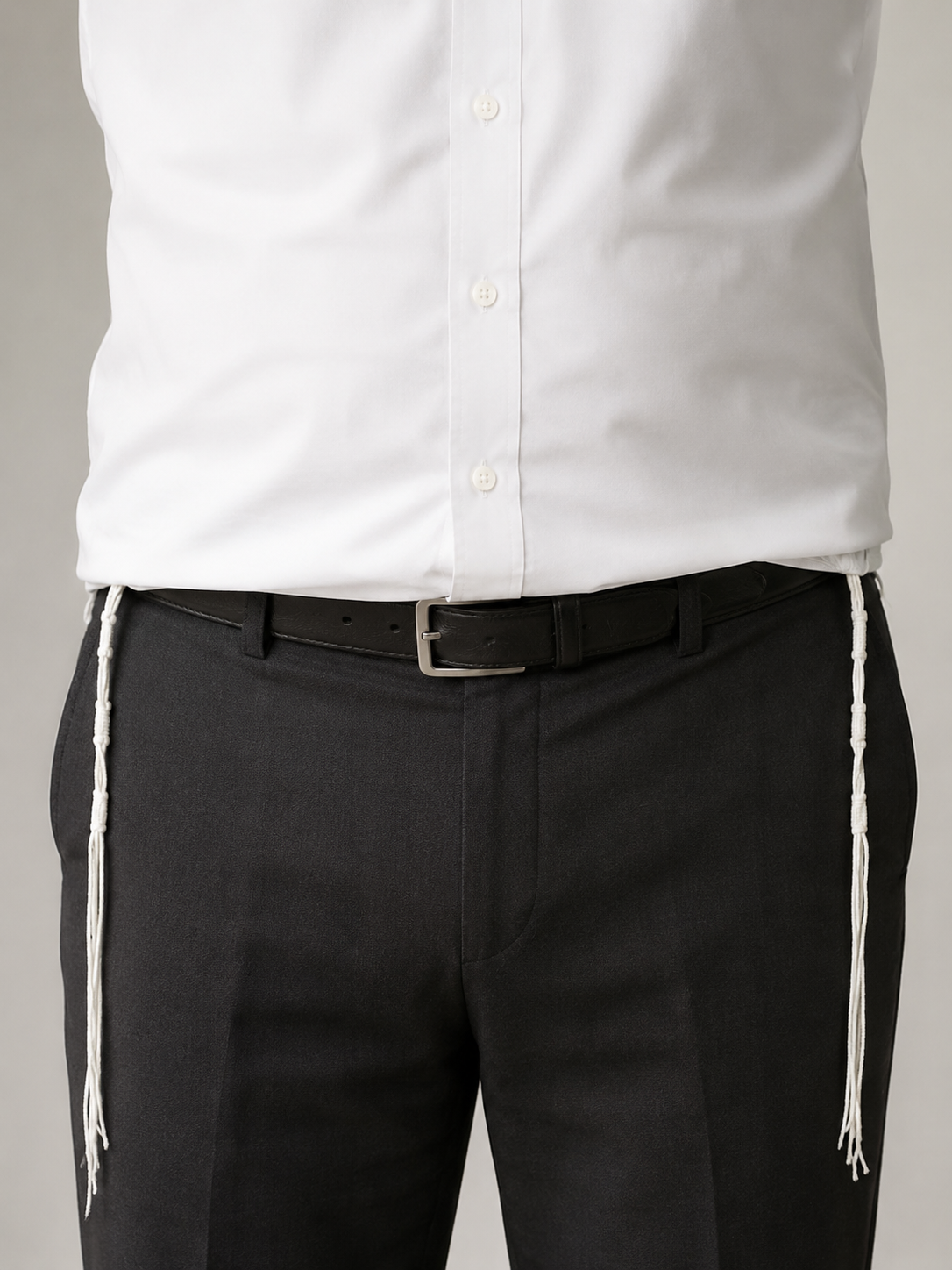
This week’s parasha ends with the mitzvah of tzitzit, which we mention every day in Keriat Shema. A major discussion among Sephardim is whether tzitzit should be tucked in or left out.
The Contradiction in the Tur
The Tur (Siman 8) writes that when a person wakes up in the morning, he must first wash his hands before making any berachot. Since one may not make a berachah before washing, what should he do regarding tzitzit?
The Tur says that he can first go wash his hands and then put on his tzitzit. But if his undershirt has tzitzit on it, and he needs to put that on first, he may and then after go wash his hands.
From the context, it is clear that this garment was worn underneath the person’s clothing, like an undershirt. The Bet Yosef points out that this seems to indicate that the beged (garment) of the tzitzit should be worn underneath one’s clothing.
Another Source Says the Opposite
The Bet Yosef then notes another statement from the Tur. In Siman 24, the Tur explains that the purpose of tzitzit is to remind us of all the mitzvot. The gematria of tzitzit, together with the knots and strings, equals 613.
The Bet Yosef asks: if tzitzit are supposed to remind us of the mitzvot, then we must be able to see them. The pasuk says, “U’re’item oto“ — “You shall see it.” This sounds like the tzitzit should be visible.
So the Bet Yosef finds a contradiction in the Tur. One source implies the beged is worn underneath the clothing, while another implies it should be worn on top.
The Shulhan Aruch’s Ruling
Although the Bet Yosef remains uncertain, in the Shulhan Aruch he rules in two places that the beged should be worn on top of the clothing. In Siman 8:11, and again in 24:1.
The View of the Arizal
So where does the practice of wearing it underneath come from?
The Magen Avraham (Siman 8) brings from the Zohar and the Arizal that the talit katan should be worn underneath one’s clothing.
Rabbi Chaim Vital, the primary student of the Arizal, testifies that the Arizal wore his tzitzit underneath his clothing. He writes very strongly:
Anyone who proudly wears it over his clothing is making a great mistake and is acting contrary to the truth.
How Do We Follow the Arizal Against Maran?
The Ma’amar Mordechai explains that according to strict halachah, Maran is correct and the beged should be worn on top. However, the accepted minhag became to wear it underneath based on the Zohar and the Arizal.
Really Maran holds its ok to wear it underneath. What he says in Shuhan Aruch was meant it as a higher level of mitzvah, not an absolute obligation.
Since we have a clear tradition from the Zohar and the Arizal, the accepted practice became to wear the beged underneath the shirt.
This follows a well-known principle: when there is a conflict between halachah and Kabbalah, many Sephardic authorities follow the teachings of the Arizal.
What About the Strings?
Up until now we have only discussed the beged itself.
The Magen Avraham then brings the Levush, who says that although the beged should be underneath the shirt, the strings should remain outside.
Why?
Because the pasuk says:
“U’re’item oto” — “You shall see it.”
The strings should remain visible so they can remind a person of the mitzvot.
The Mishnah Berurah’s Strong Language
The Mishnah Berurah writes very strongly that people who tuck their tzitzit strings into their pants are ignoring the pasuk of “U’re’item oto.”
He even says that they are degrading the mitzvah and will be held accountable for it.
Because of this, Ashkenazim are generally very careful to leave their tzitzit out.
How Do Sephardim Answer This?
The question is obvious: if Sephardim tuck in their tzitzit, how do we fulfill “U’re’item oto“?
The Yabia Omer (2:1) and the Ohr LeTzion (2:2) discuss this question and offer several answers.
Answer #1: You Only Need to See Them Once
The Tur quotes the Ba’al Ha’Itur, who explains that “U’re’item oto” does not mean you must see your tzitzit all day long.
When you put them on and make the berachah, you see them. That fulfills the pasuk.
Afterward, they may be tucked in.
Answer #2: Intellectual Seeing
The Yabia Omer explains that “seeing” does not necessarily mean physical sight.
It can mean keeping the mitzvah in mind and constantly thinking about the tzitzit and what they represent. This is called re’iyah sichlit — intellectual seeing.
Even if the tzitzit are not visible, a person can still fulfill the purpose of the pasuk.
Answer #3: They Are Available to Be Seen
The Ohr LeTzion gives another answer.
The pasuk only requires that the tzitzit be available to be seen. Since a person can easily take them out and look at them whenever he wants, he fulfills “U’re’item oto.”
Is Tucking Them In a Bizayon (disgrace)?
What about the Mishnah Berurah’s claim that tucking in tzitzit is degrading the mitzvah?
The answer is that there is a major difference.
If someone hides his tzitzit because he is embarrassed to be seen wearing them, that is indeed a bizayon to the mitzvah.
However, Sephardim tuck them in because that is their accepted minhag based on the Zohar and the Arizal. They are not embarrassed by the mitzvah at all.
Therefore, there is no bizayon.
Rabbi Yaakov Hillel’s Opinion
One major contemporary exception is Rabbi Yaakov Hillel.
Rabbi Yaakov Hillel holds that the beged should be worn underneath the shirt, but the tzitzit strings should remain outside, following the Levush and Magen Avraham.
He wrote extensively to explain that even according to the Zohar, the strings should be visible.
The Debate with Hacham Yitzchak Yosef
Rabbi Yaakov Hillel discussed this issue many times with Rabbi Yitzhak Yosef.
Hacham Yitzhak Yosef argued that the accepted Sephardic minhag has always been to tuck in the tzitzit. There are those who testified that the great Kaf HaHaim tucked in his tzitzit.
Rabbi Yaakov Hillel disputed this evidence that he really left them out. Others just couldn’t see them because they were covered by his long haluk.
Hacham Yitzchak responded that even if the strings technically remained outside but were covered by a long outer garment, the result is the same—they were not visible.
Practical Halachah
The accepted Sephardic practice is to tuck in the tzitzit.
The Ohr LeTzion and Hacham Yitzchak Yosef write that a yeshivah student learning in an Ashkenazi yeshivah may leave them out. The Ohr LeTzion adds that if a person is around less observant people and feels that visible tzitzit will strengthen his yirat shamayim, he may also leave them out.
However, Hacham Yitzchak Yosef strongly encourages married Sephardim to follow the traditional Sephardic minhag and keep their tzitzit tucked in.
In conclusion, although there is significant discussion regarding the strings, the accepted Sephardic minhag based on the Zohar, the Arizal, and generations of Sephardic practice is that both the beged and the tzitzit are worn underneath one’s clothing.