By Rabbi Yishai Natan:
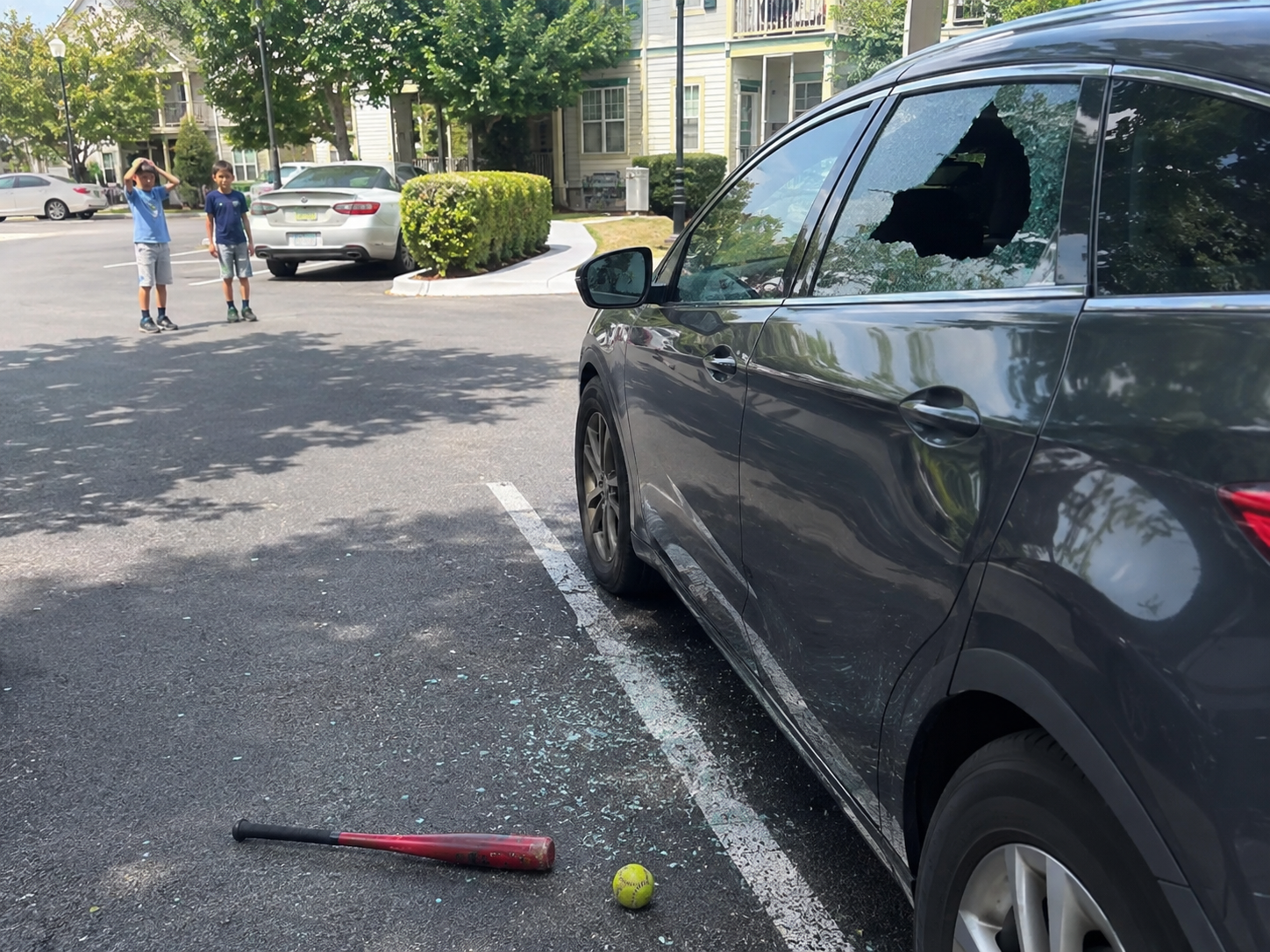
My nine-year-old son was playing baseball with his friends in the parking lot of our development, as they often do. They were using a soft ball so that they would not break any windows. When it was his turn to bat, he accidentally let go of the bat, and it flew into someone’s car window.
Do I need to pay for the window? Does my son have to pay? Or maybe does no one have to pay?
The Parent’s Responsibility
You would not have a hiyuv to pay for the damage, since you were not the one who caused it and you did not have a responsibility to guard your son. This is contrary to the common assumption that a person would be patur if his cat drank someone else’s milk, but hayav if his child caused damage. In halachah, however, it is exactly the opposite[1].
A Katan Who Causes Damage
Regarding your son’s responsibility to pay, the Mishnah in Baba Kama (87a) says that an encounter with a heresh, shoteh, or katan is unfortunate. If someone damages them, he is hayav. However, if they damage someone else, they are patur. An encounter with a servant or a woman is also unfortunate for this reason, but they are required to pay later. It is clear from this Mishnah that your son is patur. This is also stated in Shulhan Aruch (HM 424:8), without anyone disagreeing.
Is He Responsible After Bar Mitzvah?
The question is whether he will become hayav after reaching Bar Mitzvah age. The poskim infer from this Mishnah that a katan who causes damage remains patur even after he becomes older. The Mishnah separates the case of a katan from the cases of a woman and a servant. It says that a servant and a woman must pay later, implying that a katan never has to pay.
The reason is that a servant and a woman are truly responsible to pay. However, a technical issue prevents them from paying immediately, since they do not have their own money. Anything they own belongs to the master or husband. A katan, however, is patur from the beginning because he does not have proper understanding. Therefore, he remains patur even after he grows older. Maran (ibid.) also brings this halachah from the Rambam, and none of the poskim on the page object.
The Case of Rav Ashi
However, the Gemara in Baba Kama (98b) relates that Rafram pressured Rav Ashi to pay for damage that he had caused[2]. Rashi explains that Rav Ashi caused this damage when he was a child, since it is difficult to believe that he would have caused such damage as an adult and then refused to pay. Based on this, the Maharach Ohr Zarua[3] attempts to prove that a katan is required to pay after he becomes older, since Rafram still required Rav Ashi to pay once he had grown up.
However, the accepted halachic pesak does not follow the Ohr Zarua, since he is a stand-alone opinion[4]. Several answers are offered to counter the proof of the Ohr Zarua. The Taz (OH 343) answers that Rav Ashi was not truly hayav min hadin. Rather, Rafram pressured him to pay only lifnim mishurat hadin, beyond the strict requirement of the law. The Maharam Padawa (90) answers that Rav Ashi was already over the age of Bar Mitzvah when the damage occurred. All Rashi meant was that Rav Ashi was younger at the time and had not yet become the Gadol Hador that he was when Rafram later required him to pay.
Lifnim Mishurat Hadin
The Mishnah Berurah (OH 343:9) follows the opinion of the Taz mentioned above. He rules that the katan is completely patur, but should pay the entire amount lifnim mishurat hadin.
Latzet Yede Shamayim
The Pit’hei Teshuvah (HM 349:2) quotes the Shevut Yaakov, who rules that although a katan remains patur in Bet Din after he grows older, he is still required to pay latzet yede Shamayim, in order to fulfill his obligation before Heaven. However, he is not required to pay the entire amount. So too, the Kaf HaHayim (343:35-36) quotes the Sefer Hasidim, who says that he is required to pay[5]. The Kaf HaHayim explains that this obligation is only latzet yede Shamayim, and he is not required to pay the entire amount like the Shevut Yaakov [6].
Midat Hasidut
However, Hacham Ovadia Yosef[7] points out that Maran and the other poskim who do not mention any obligation apparently do not follow the Shevut Yaakov. According to their opinion, the katan remains patur even latzet yede Shamayim. However, Hacham Ovadia explains that the Sefer Hasidim means that paying is a midat hasidut, an act of exceptional righteousness. He adds that paying for only a portion of the damage is sufficient.
Drew Tumah Upon Himself
The Bach (OH 343) writes also that he is patur and has no punishment for the damage, however, we can apply the pasuk ‘Even without knowledge, it is not good for the soul’ (mishlei 19:2). Although a child sins without knowledge, it is not good for his soul because he drew tumah upon it from the realm of evil. Therefore, when he gets older, it is good for him to do teshuva on his own on all his past deeds.
Conclusion
In conclusion, you definitely do not have to pay for the damage. Your son is also patur at this time. After he becomes older, the Mishnah Berurah holds that he should pay the entire amount lifnim mishurat hadin. The Kaf HaHayim holds that he should pay for a portion of the damage latzet yede Shamayim. Hacham Ovadia Yosef holds that paying a portion of the damage is a midat hasidut. And the Bach does not say how much he should pay, but says that he should do teshuva to remove the impurity he drew upon himself.
Rav Moshe Shternbuch[8] points out that there may be a widespread minhag for parents to pay for damage caused by their children. However, it is not a clear minhag when the damage was caused through grama, indirect causation, or when the damage is significant. It would be hard to establish a minhag in your case.
[1] Ma’aseh Ish v. 4 pg 98, in the name of Rav Chaim of Brisk
[2] It was caused through garmi, meaning direct causative damage. Rav Ashi had burned someone’s loan document, which prevented the lender from proving that he was owed money. The borrower later denied the loan, and without the document, the lender was unable to collect the money owed to him.
[3] In Hagahot Ashri, Baba Kama 8:9
[4] Shu”t Rav Akiva Eiger 147, Bach 343
[5] He brings a proof from Yoshiyahu, who was the king of Yisrael at a very young age and did many horrible averot and later repented for all the things he did as a youth.
[6] This is based on the Rama (ibid.), who writes that he should accept upon himself “something” as a form of teshuvah.
[7] Yabia Omer 8:6
[8] Teshuvot VeHanhagot 4:317