 Print this Article
Rabbi Yishai Natan –
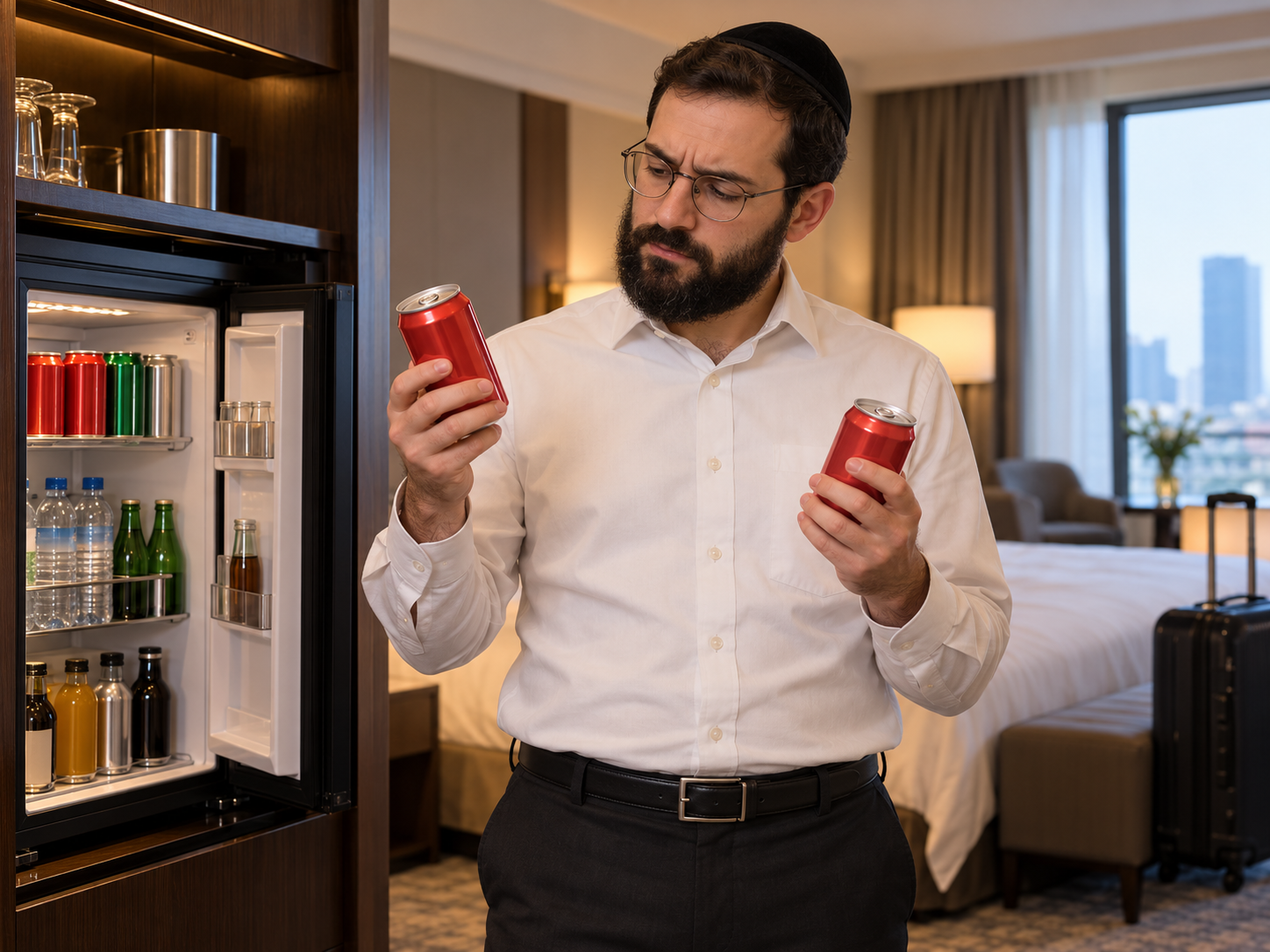
I recently stayed at a Jewish-owned hotel. The refrigerator in my room was fully stocked with different drinks, but the prices were extremely high. I wanted a cold soda, but I saw that the hotel was charging $8 for a can that I could buy for about $1 from a vending machine down the street.
I felt that charging $8 for a simple can of soda was not right. I thought to myself that the hotel should not lose anything if I simply replaced the can. So I drank the cold soda from the hotel refrigerator and planned to later buy the exact same brand and size can for $1 and put it back in the refrigerator before checking out. This way, the hotel would still have the same type of soda to sell to the next guest.
Was I allowed to swap the cans? Also, isn’t charging $8 for a can of soda considered ona’ah?
Is the Hotel Price Ona’ah?
Charging more than one-sixth above the proper price can sometimes be considered ona’ah. However, the proper price is determined by the type of seller and the place where the item is being sold. Therefore, the price of a soda in a grocery store cannot necessarily be compared to the price of a soda sitting cold in a hotel-room refrigerator.
The Mishnah (Erechin 24a) says that a pearl is valued according to what it is worth in the town where it is located, even if it would sell for much more in a nearby city. Similarly, the Gemara (Bava Kamma 11a) shows that even the value of an animal carcass can change depending on whether it is still at the bottom of a pit or has already been brought up to street level. We see from here that value is determined according to the time, place, and situation of the item.
Therefore, if the hotel is charging an amount that is normal for similar hotels, there would not be ona’ah simply because the same soda costs much less in a regular store. This is similar to an amusement park or other venue charging much more for drinks than a grocery store.
Can You Pay by Replacing the Can?
Let’s now consider you a purchaser of the soda can. Can you pay for the soda you purchased by giving the seller an item of equal value instead of money? Tosafot (Bava Kamma 9a) writes that a hired worker must be paid with money and not with objects of equal value. The Bet Yosef (Hoshen Mishpat 101) cites the Ritva (Bava Metzia 45b), who says that a buyer must also normally pay with money, since that is understood to be the agreement between the buyer and seller. Based on this, Maran in the Shulhan Aruch (101:6) rules that payment for a purchase should be made with money. The Ketzot HaHoshen (101:3), however, cites Tosafot, who says that under certain circumstances a person who bought a field on credit may return that same field as payment instead of paying cash.
Nevertheless, in our case there are several reasons why replacing the can would not work. First, Maran Bet Yosef rules like the Ritva, who requires payment with money. Second, even according to Tosafot, the case involved returning the actual land that had been purchased, not a replacement. Third, the replacement can is not worth the same amount when you buy it from the vending machine. It only gains the higher hotel value after it is used as payment and placed in the hotel refrigerator and becomes available for the hotel to sell.
Taking It Without Permission
More importantly, you are not considered a regular purchaser. If you take the soda with the intention of not paying the hotel’s price, you are taking their property without permission. Although you may not intend to steal, halachically this gives you the status of a gazlan. The Shulhan Aruch (Hoshen Mishpat 366:3) rules that someone who uses another person’s property without permission has the status of a gazlan. The hotel gives permission to take the soda only on the condition that you are purchasing it at the hotel’s price. If you take it while planning not to pay that price, you are using the hotel’s property without its permission.
Gazlan Returning the Same Item
If a gazlan still has the actual object that he took, he can return it and say, hareh shelcha lefanecha — “Here is your item in front of you”. However, this applies only when he returns the actual object that he took. He cannot use up the original item and then replace it with another identical one because he cannot say “Here is your item in front of you”, since it is not “his” item. Therefore, once you drank the soda, the original can of soda was gone. You must now pay its value and cannot simply replace it with another can (Shulhan Aruch, Hoshen Mishpat 363:2).
We Don’t Need Your Can
There is another reason why replacing the soda does not solve the problem. The Rama, quoting the Rosh (Hoshen Mishpat 304:5), writes that if someone damages another person’s barrel of wine on market day, he must pay the value of the barrel. He cannot simply replace it with another barrel on a later market day for the seller to sell. The owner can say, “I already have enough wine now. I do not need another barrel.” The same idea applies here. The hotel can say, “We already have enough cans of soda. We do not need the can you bought. We were selling our can for money.”
Conclusion
It is assur to take a drink from a hotel minibar with the intention of replacing it instead of paying the price charged by the hotel. If the hotel’s price is normal for comparable hotels, the fact that the same soda can be purchased much cheaper elsewhere does not make it ona’ah. By taking the soda without accepting the hotel’s price, you are using its property without permission. Once you drank it, you can no longer return the actual item and must pay its full value in money.