 Print this Article
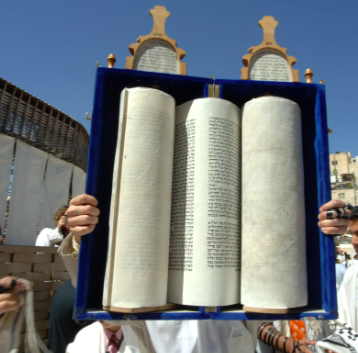
HaRav Yishai Natan –
The Source for Hagba’ah
The pasuk in Devarim (27, 26) says:
“Arur asher lo yakim et divrei haTorah hazot” — cursed is the person who does not uphold the words of this Torah.
The Yerushalmi in Sotah (7:4) says, “Rabbi Shimon ben Yakim omer: zeh hahazzan” — this refers to the hazzan. The Ramban explains that the hazzan refers to the magbiah, the person performing hagba’ah. If he does not properly show the writing of the Sefer Torah to the entire kahal, he is included in this warning. Therefore, the magbiah must make sure that everyone in the Bet Knesset has an opportunity to see the writing.
Where does the practice of hagba’ah come from? Interestingly, the Tur does not mention it. The source is Masechet Soferim, quoted by the Bet Yosef and then by the Shulhan Aruch (OH 134:2). Masechet Soferim says that the Sefer Torah should be lifted and its writing shown to the people standing on the right, left, front, and back. It concludes, “Shemitzvah lechol anashim venashim lirot haketav velichroa” — it is a mitzvah for all men and women to see the writing and bow. This is the basic source for the laws of hagba’ah.
A Mitzvah to See the Writing
The Kaf HaHayim (18) writes that it is a mitzvah to be present for hagba’ah. Therefore, if someone is outside the Bet Knesset and knows that hagba’ah is taking place, he should come inside to see the writing. This is an expression of kavod haTorah.
Does the Sefer Torah have to be opened to the exact place that will be read? Sometimes hagba’ah is performed, and only afterward they realize that the Sefer Torah was not rolled to the correct place. Everyone agrees that hagba’ah does not need to be repeated. In fact, the poskim do not require the Sefer Torah to be opened to the exact place of that day’s reading. The purpose is to honor and display the Sefer Torah. There are opinions that say it is preferable to have it opened to the correct place, but this is certainly not required.
This can be helpful for Ashkenazim on Simhat Torah. When performing hagba’ah at the beginning of Bereshit, almost the entire Sefer Torah is rolled onto one side, making it difficult to lift. Technically, it could be rolled to a more balanced position before hagba’ah. For Sephardim, this issue is generally not relevant because the Sefer Torah remains inside its case.
Which Direction Should He Turn?
Masechet Soferim says to show the writing to those standing on the right, left, front, and back. This raises an interesting question: Which direction should the magbiah turn first?
For Sephardim, who display the writing outward, turning to the right naturally shows the writing to the people on the right. For Ashkenazim, however, the writing faces the magbiah. Therefore, turning to the right actually displays the writing toward the people on his left.
Nevertheless, the main concern is the direction in which the magbiah turns. There is a general rule that when turning during a mitzvah, one turns toward the right. This is seen with the Kohanim walking around the mizbe’ah and with the movements of the lulav. Therefore, the magbiah should begin by turning toward his right.
What Is the Order of Turning?
After turning to the right, what comes next?
The wording of Masechet Soferim seems to indicate an order of right, left, front, and back. Some people therefore follow that order. However, in practice, this can become confusing. More importantly, when moving back and forth between different directions, it is easy to miss part of the kahal.
Since the main purpose is to make sure that everyone sees the writing, the better and simpler method is to turn to the right and then continue all the way around in one complete circle. This makes it much easier to ensure that nobody is missed.
Looking at the Actual Letters
The Ba’er Hetev (134:5), quoting the Arizal, writes that a person should look at the letters of the Sefer Torah during hagba’ah. He writes that doing so causes a great spiritual light to be drawn upon the person. Therefore, one should try to actually look at the writing rather than simply looking in the general direction of the open Sefer Torah.
The Kaf HaHayim (13), quoting the Ben Ish Hai in Toldot, writes that it is proper to find a word in the Sefer Torah that begins with the first letter of one’s name. For example, someone whose name begins with a yud should try to find a word beginning with a yud. The Kaf HaHayim adds that he heard that this is a segulah for hatzlahah.
Should You Move Closer?
If someone is standing far away and wants to see the letters, he should move closer before hagba’ah. In a Sephardic Bet Knesset, where hagba’ah is performed before the reading, a person should make his way forward as the Sefer Torah is being taken out. He should not wait until the last second and then run toward the front, especially if doing so will cause pushing or disturb others.
The Sha’arei Efrayim (10:13) expresses concern about moving closer to the Sefer Torah, since doing something that appears to be an unnecessary humra can look like ga’avah. However, the poskim disagree and explain that moving closer to see the writing is an expression of kavod haTorah. Certainly, if one is doing so to properly see the letters, there is no reason for concern.
Why Sephardim Open the Sefer Torah While Walking
This helps explain the Sephardic practice of opening the Sefer Torah near the Aron and displaying it while walking toward the bimah. The purpose is to allow everyone in the Bet Knesset to see the writing. If hagba’ah were performed only at the bimah, people standing farther away might not be able to see it clearly.
Hacham Ovadia, in Yabia Omer (7:16), quotes Halachot Ketanot, who describes a very long and narrow Bet Knesset. They would open the Sefer Torah and carry it past the bimah toward the back so that everyone could see the writing.
Normally, one should not take a Sefer Torah out of its regular path simply so that someone can kiss it. However, bringing the open Sefer Torah around so that people can see its writing is different. Since the purpose itself is kavod haTorah, it is permitted.
Hagba’ah: Before or After?
There is no absolute requirement that hagba’ah must be performed specifically before or after Keriat HaTorah.
The Shulhan Aruch discusses the law of hagba’ah in siman 134, before the laws of Keriat HaTorah. Sephardim therefore follow the practice of performing hagba’ah before the reading. The Rama (ibid.), however, writes that the Ashkenazi minhag is to perform hagba’ah after the reading.
Hacham Ovadia also records that the minhag in Yerushalayim and other places was to open the Sefer Torah again after the reading while returning it to the Aron. This makes sense because someone who was unable to see the writing on the way to the bimah may have another opportunity to see it on the way back.
Pinky, Tzitzit, or Bow?
What should a person do when the open Sefer Torah passes in front of him?
There is a well-known minhag to point toward the Sefer Torah with the pinky. The Me’am Lo’ez, in this week’s parashah, mentions that he saw this custom. However, there does not appear to be a clear source explaining specifically why the pinky is used.
The Me’am Lo’ez also mentions the custom of touching the tzitzit toward the Sefer Torah and then kissing them. These are accepted minhagim, but they are not the practice mentioned in the original source for hagba’ah.
The practice that does have an explicit source is bowing. Masechet Soferim, as quoted by the Shulhan Aruch, says, “Shemitzvah lechol anashim venashim lirot haketav velichroa” — it is a mitzvah for men and women to see the writing and bow.
Some poskim questioned whether one should bow toward a Sefer Torah, since it might appear as though one is bowing in worship. However, Hacham Ovadia (Yabia Omer 5:8:4) and many other poskim maintain that there is no concern. One is not worshipping the Sefer Torah. Rather, the bow is an expression of kavod haTorah. Therefore, of all these practices, bowing is the one that has the clearest source in Masechet Soferim and the Shulhan Aruch.
Women Seeing the Sefer Torah
Finally, Masechet Soferim specifically says “anashim venashim” — both men and women should see the writing.
In many Batei Knesset, this can be difficult because the women are behind a curtain or partition. Some Batei Knesset therefore open the curtain during hagba’ah so that the women can see the writing. This fits directly with the wording of Masechet Soferim that women, as well as men, should see the writing.