 Print this Article
By Rabbi Yishai Natan:
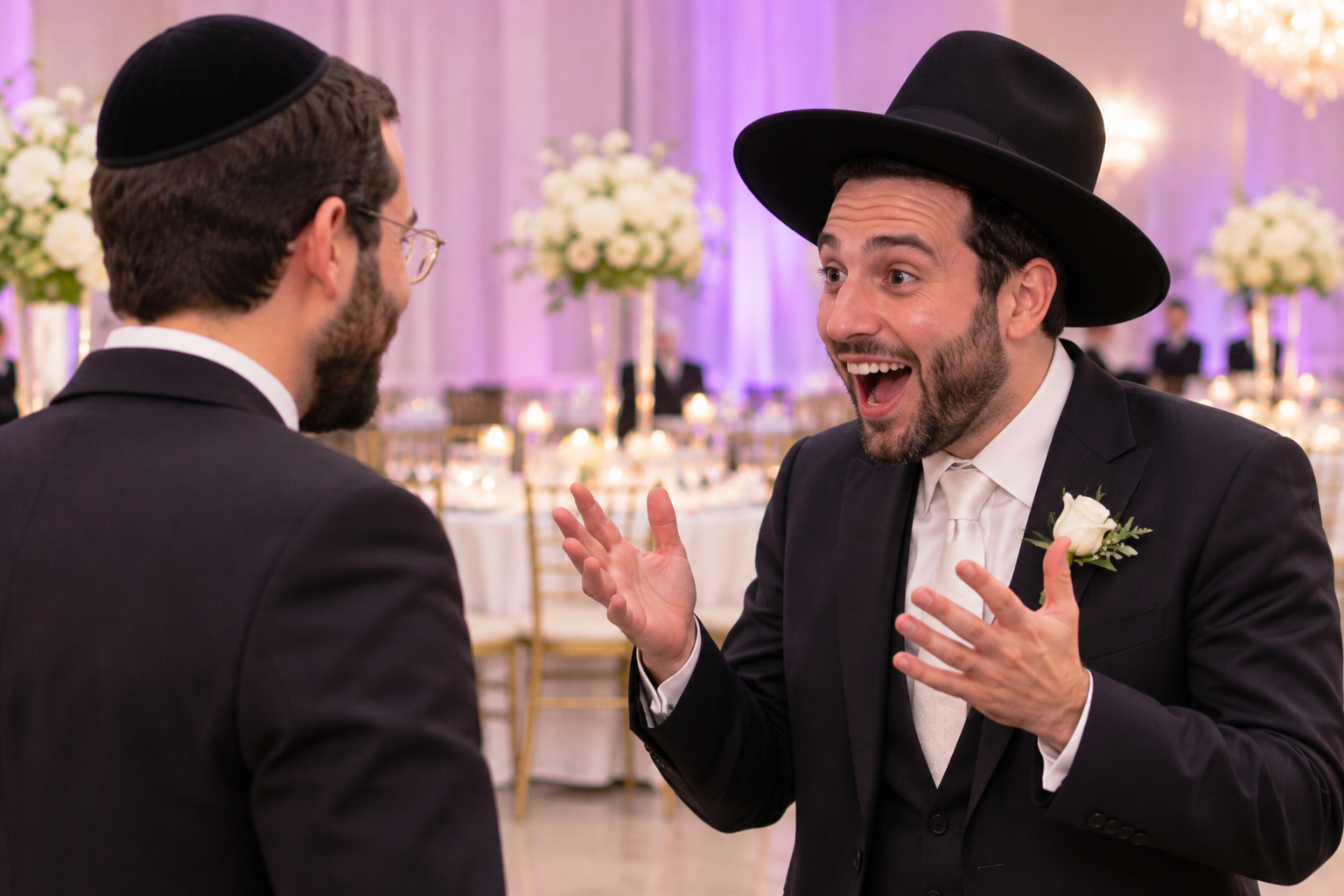
I live in Brooklyn and recently traveled to Lakewood to attend a wedding. While driving through town, I passed another wedding hall and suddenly remembered that a friend of mine was getting married there that same night. Since I was already nearby, I decided to stop in for a few minutes to wish him Mazal Tov. When I walked into the hall, the hatan was surprised and excited to see me. He gave me a big hug and thanked me for coming all the way from Brooklyn to celebrate with him. I realized that he assumed I had made the trip especially for his wedding, when in truth, I had only stopped by because I happened to be passing his hall. I felt uncomfortable correcting him and ruining his excitement, especially on his wedding night. On the other hand, I did not want him to think I had gone out of my way for him when I really hadn’t.
Was I required to tell the hatan that I had not made a special trip for his wedding? Was remaining silent considered genevat da’at?
Opening a Barrel for a Guest
The Gemara in Hullin (94a) says that if someone was already planning to open a new barrel of wine to sell, he may not open it in front of his guest without informing him that it was not opened in his honor. Otherwise, the guest may mistakenly believe that his host opened an entire barrel especially for him. From this Gemara, it seems that whenever someone may mistakenly think you did something special for him, you must clarify the truth.
When Someone Misleads Himself
However, the Gemara there gives another case. If an animal was a terefa and could not be eaten by Jews, the seller was allowed to announce in the marketplace, “Meat has fallen for the soldiers.” This was a code phrase that allowed the Jews to understand that the meat was terefa, while the gentiles would not realize it. Although the meat was mutar for the gentiles to eat, they might not want to buy meat that Jews themselves would not eat. Nevertheless, the Gemara says this is not genevat da’at, because the gentiles misled themselves into assuming that the meat was properly shechted. The seller never told them that it was.
Similarly, the Gemara relates that Mar Zutra was traveling toward the city of Mahuza when Rava and Rav Safra happened to be leaving the city. Mar Zutra assumed that they had come out specifically to greet him. Rav Safra wanted to correct his misunderstanding, but Rava told him that this was unnecessary. They had done nothing to create that impression; Mar Zutra had made the assumption on his own.
The Three Opinions
The Rishonim discuss how to reconcile these cases with the case of the wine barrel. Rashi explains that the wine-barrel case involved the host actually telling or indicating to his guest that he was opening the barrel for him. That is assur. Had he simply opened the barrel without saying anything, it would have been mutar. Similarly, the meat seller never said that the meat was shechted, and Rava and Rav Safra never indicated that they came out to greet Mar Zutra.
Tosafot disagrees. According to Tosafot, opening the barrel is assur even without saying anything. Opening an entire barrel was unusual, so the guest had no reason to assume that the host would have opened it anyway. In the other cases, however, the gentiles should have realized that the meat might be terefa, and Mar Zutra should have considered that Rava and Rav Safra might simply have been leaving the city when he arrived.
The Ran gives a third explanation. The barrel case is assur because the host intended to mislead his guest. In the other cases, there was no intention to trick anyone.
Therefore, according to Rashi, genevat da’at occurs when you say or indicate that you are doing something especially for the other person. According to Tosafot, it can be assur even without saying anything when the other person has no reasonable reason to assume otherwise. According to the Ran, it depends on whether your intention is to deceive him.
The Halachah
Maran in Shulhan Aruch (Hoshen Mishpat 228:6) appears to follow the approach of Tosafot, although the Rashal understands that the Rambam follows the Ran. Maran writes that when the other person should have realized that something was not necessarily being done for him, and he misled himself, there is no obligation to correct him.
Therefore, in your case, since you traveled from Brooklyn to Lakewood and unexpectedly stopped by your friend’s wedding, the question depends on whether your actions caused him to believe that you came specifically for him. If you simply walked into the wedding and wished the hatan Mazal Tov, without saying or indicating that you made a special trip, there is room to permit it. After all, it is common for someone to attend more than one wedding on the same night. Your friend should not necessarily assume that you traveled all the way from Brooklyn just for his wedding.
When Silence Becomes Agreement
The Yerushalmi (Shevi’it 10:3) says that if people honor someone because they mistakenly believe he knows two masechtot, when he only knows one, he must correct them. The Maharit (2, Orah Haim 8) asks why this is different from someone who misleads himself. He answers that when people praise him in his presence, his silence is considered agreement and becomes genevat da’at. Accordingly, when the hatan thanked you for making a special trip, perhaps you were required to correct him. However, the Hida (Haim Sha’al 1:71:6) questions the Maharit. After all, Mar Zutra also expressed his mistaken assumption directly, yet Rava said there was no need to correct him. Furthermore, the Minhat Yitzhak (3:104) explains that the Yerushalmi concerns the special humility required of a talmid hacham, rather than the general prohibition of genevat da’at.
Rav Shlomo Zalman Auerbach Story
There is a well-known story about Rav Shlomo Zalman Auerbach (Sefer Tet Emet LeYaakov 5:125). He once attended a wedding and specifically told the family that he had not come especially for their wedding. When people were amazed by his honesty, he responded that this is an explicit Gemara. This story does not clearly fit with all three opinions discussed above and requires further examination to understand why Rav Shlomo Zalman felt obligated to clarify his reason for attending.